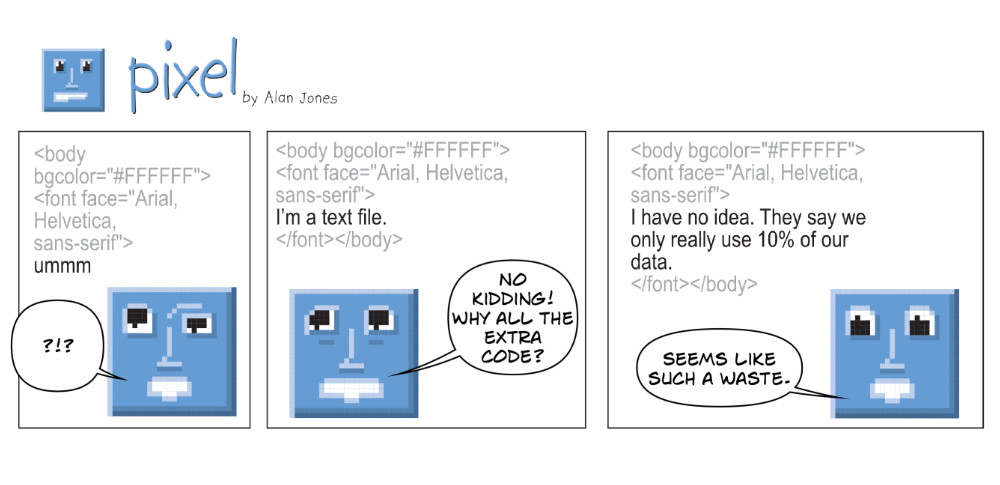
Pixel
Pixel  and his friend, Al Gore-ithm
  try and make sense of their digital world.
- Details
- Written by: Alan Jones
- Read Time: 12 mins
- Hits: 2181
Author: Alan R. Jones
Date: June 7, 2025
Abstract
This paper argues that the three rivers in Daniel—Ulai (Dan 8), Euphrates (Dan 9), and Tigris (Dan 10)—associated with divine figures, likely Christophanies, form a typological motif informing Jesus’ walking on water (Matt 14:22–33; Mark 6:45–52; John 6:16–21).
Full typological arc:
Genesis 1:2 - Spirit hovers over chaos waters
Exodus 14 - Israel passes through on dry ground (Philo's Moses typology)
Psalm 74 - Yahweh crushes chaos monsters
Daniel 8, 10 - Divine figures appear over rivers
Isaiah 45 - Cyrus conquers by Euphrates
Job 9, 38 - Yahweh treads on sea
Gospels - Jesus walks on water
Acts/Epistles - Church confronts principalities (Eph 6:12)
Revelation 21:1 - "No more sea"
Read more: The Rivers of Daniel and the Water-Walking Christ: A Messianic Mastery Over Cosmic Chaos
- Details
- Written by: Alan Jones
- Read Time: 30 mins
- Hits: 1568
Author: Alan R. Jones
Date: June 19, 2025
Abstract
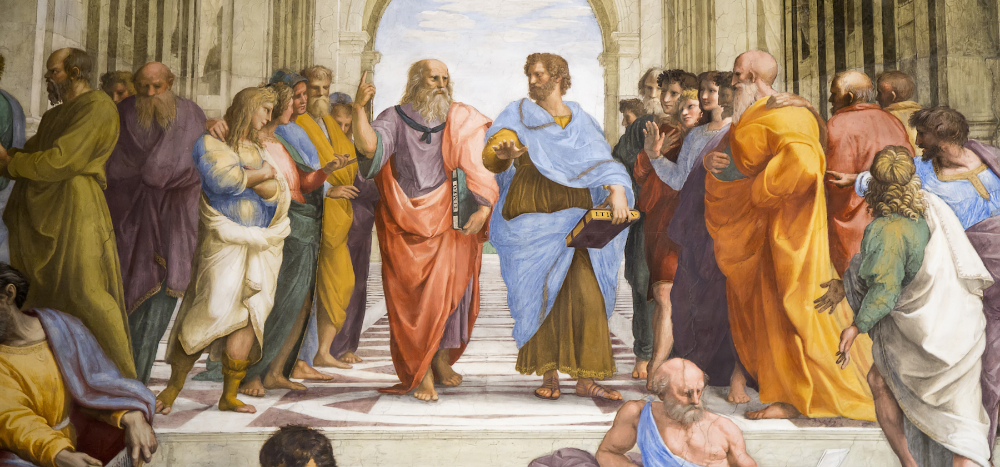
This paper can be thought of as a spiritual cartography, an attempt to speculatively decode the generational and philosophical skeleton of Western civilization and reveal its spiritual underpinnings.
- Details
- Written by: Alan Jones
- Read Time: 14 mins
- Hits: 1214
Author: Alan R Jones
Date: June 4, 2025
Abstract
This paper proposes that the “sons of God” (bene ha’Elohim) of Genesis 6, Deuteronomy 32, and Job, also known as the “watchers” (‘irin) in Daniel 4, underwent a divine restriction following their pre- and post-flood rebellions.
- Details
- Written by: Alan Jones
- Read Time: 26 mins
- Hits: 1135
Abstract
This paper contends that faith, particularly within the framework of the "mesotopia," operates as a phenomenology of the possible, fundamentally reached by the necessary.
Read more: Faith as Phenomenology: When Providence Precedes Potential
- Details
- Written by: Alan Jones
- Read Time: 20 mins
- Hits: 1054
A Rebuttal to Kierkegaard’s Teleological Suspension in the Akedah
Abstract:
Søren Kierkegaard, in Fear and Trembling, introduces the concept of the “teleological suspension of the ethical,” positing that Abraham’s willingness to sacrifice Isaac in Genesis 22 represents a paradoxical act of faith that suspends universal ethical norms in favor of a divine command. Kierkegaard argues that the ethical, as the universal, is superseded by the individual’s absolute relation to God, which he calls the “absurd” (Kierkegaard, 1843/2006, p. 54).
- Details
- Written by: Alan Jones
- Read Time: 17 mins
- Hits: 1029
An aricle based on an AI conversation with Google's Gemini:
I am interested in Predictability! Especially in complex human systems.
To this end I would like to discuss: Generational Theory, Complexity (or Chaos) Theory, and Prophecy.
Søren Kierkegaard in his book Sickness Unto Death made the following startling statements:
"The fact that God's will is the possible means I can pray; if God's will is only the necessary, then man is essentially as dumb as the beast."
and
"Only the person whose being was so shaken that he became spirit by grasping that everything is possible, only he has had dealings with God."
Below are Michael Crichton's 7 configurations of complex systems in his novel The Lost World, as they head toward, and fall over, the Chaotic Edge.
Althought these are fictional concepts–and Ian Maclaom is a fictional character–they do strike me with certain degree of accuracy. At least they serve to describe what is a very interesting topic when thinking about human systems and complexity:
Read more: The World is Not Lost
- Non-Linear progression.
- A secular linear dystopian prediction of the future is not realistic.
"Less faith in the mythology of the world, more faith in God and His story."
https://podcasts.apple.com/us/podcast/rebuilders/id1462274371?i=1000528831404
- Details
- Written by: Alan Jones
- Read Time: 13 mins
- Hits: 906
Neil Howe's book The Fourth Turning is Here is proving to be a thought provoking read. Here are exerpts from the Preface and Chapter 1 with my thoughts in Blockquote:
Preface
This book proposes that America is midway through an era of historical crisis, which- almost by definition-will lead to outcomes that are largely though not entirely beyond our control. The prospect of such radical uncertainty may fill us with dread.
All too often in the modern West we fear that any outcome not subject to our complete control must mean we are heading toward catastrophe.
Over the course of this book, I hope to persuade you of a more ancient yet also more optimistic doctrine: that our collective social life, as with so many rhythmic systems in nature, requires seasons of sudden change and radical uncertainty in order for us to thrive over time. Or, to paraphrase Blaise Pascal: History has reasons that reason knows nothing of.
Read more: Some loose thoughts from Neil Howe
- Details
- Written by: Alan Jones
- Read Time: 7 mins
- Hits: 896
I am convinced that we could save billions of wasted hours arguing if we simply used absolute terms only to define absolute concepts. Concepts like “Fact” and “Truth”.
An "established fact" should be no different from any other "fact", in fact there is only one kind of fact. And the truth is that facts are rare, and we should not use fact in place of either consensus or theory. There have been a great many ideas throughout our history that have been held by the majority but have been far from true.
- Details
- Written by: Alan Jones
- Read Time: 21 mins
- Hits: 880
Abstract
The question “Can God die?” evokes a theological paradox akin to the philosophical conundrum of an unstoppable force meeting an immovable object, while “Can God learn anything?” challenges divine omniscience. In Christian theology, these paradoxes are resolved in Jesus Christ, who, as fully divine and fully human, confronts death—the seemingly immovable object—with His omnipotent divine nature, the unstoppable force, and experiences obedience and suffering in His human nature.
- Details
- Written by: Alan Jones
- Read Time: 12 mins
- Hits: 843
I Think, Therefore Thou Art

A Relational Overthrow of the Cartesian Subject: Non-Cartesian Cartography in the Mesotopia
- Details
- Written by: Alan Jones
- Read Time: 5 mins
- Hits: 826
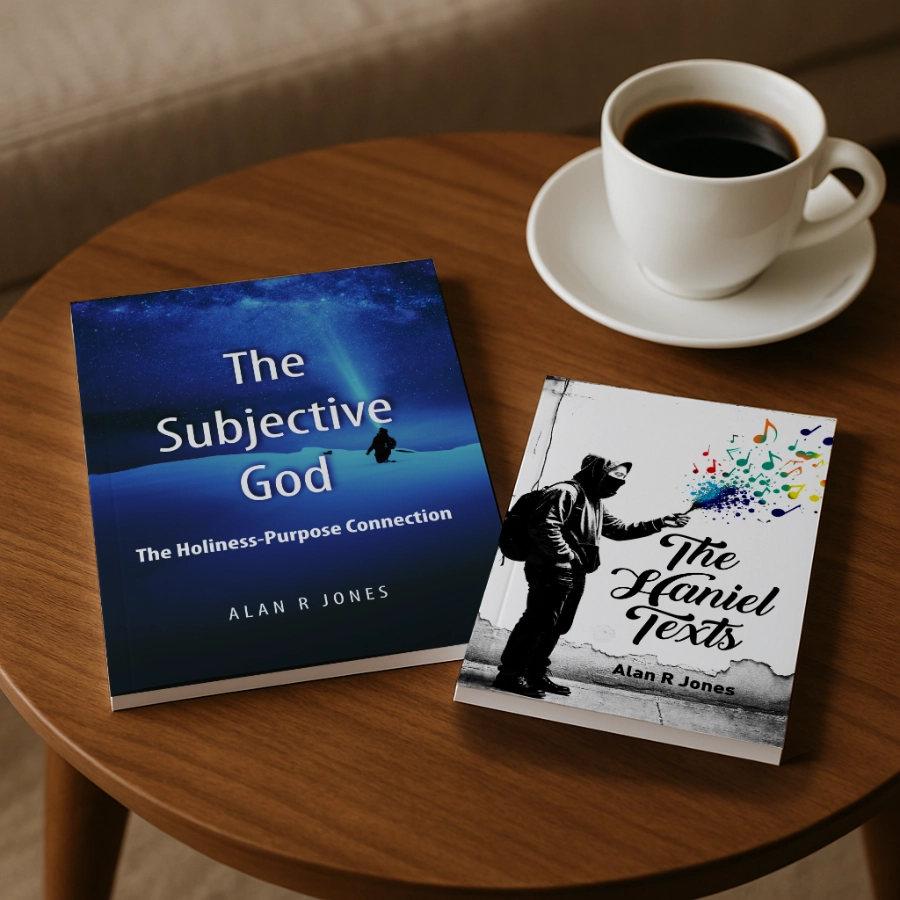
“I do not admire the excess of a virtue like courage unless I see at the same time the excess of the opposite virtue, like caution. A man does not prove his greatness by being at one extreme, but by touching both extremes and filling all the space between.” —Blaise Pascal, Pensées
Read more: Why Should You Read The Subjective God and The Haniel Texts?
- Details
- Written by: Alan Jones
- Read Time: 2 mins
- Hits: 769
We are not called to look longingly at heaven from earth;
we are called to look lovingly at earth from heaven.
2 Peter 3:11 says: "Since all these things are thus to be dissolved, what sort of people ought you to be in lives of holiness and godliness," This is an ethics question, it is not rhetorical; and it's based on an eschatological assertion. Peter isn't theorising about the end, he is basing current ethic on how the whole material universe will end! Our eschatology matters!
Paul answers Peter in Galatians 6:10: “So then, while we have opportunity, let us do good to all people…” We won't always have this opportunity, doing good will eventually be default, indistinguishable from doing anything, but now we have opportunity to shine in the darkness, to go against our animal instincts to grab, hoard, lie, steal, manipulate, and murder.
- Details
- Written by: Alan Jones
- Read Time: 14 mins
- Hits: 686
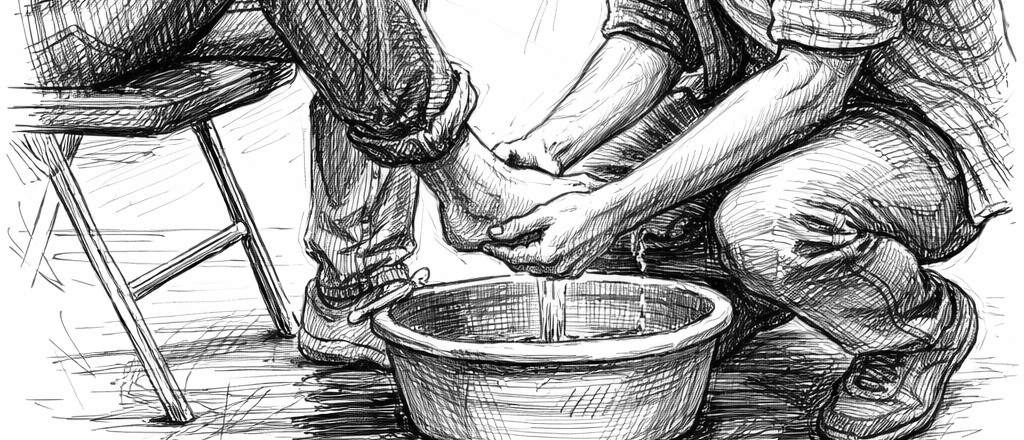
Covenantal Self-Binding and Eternal Relational Order
Author’s note
In this paper, and my book The Subjective God, I am not reframing holiness, I am recovering holiness; restoring holiness to its covenantal and participatory meaning within the biblical narrative. This is crucial for the church because, in Revelation 4 and 5 we see our God in heaven moving through the definition of “holy” to the definition of “worthy” by the sacrificial service of the Lamb that was slain. Why is He worthy? “for you were slain…” (Revelation 5:9).
We see Christ making the church also “worthy” in 2 Thessalonians 1:11 from her starting position of holy; dedicated to a single purpose, even at enormous cost.
- Details
- Written by: Alan Jones
- Read Time: 24 mins
- Hits: 670
Post-Enlightenment Reformed theology embraced a gospel with much of the spiritual components quietly removed.

- Details
- Written by: Alan Jones
- Read Time: 17 mins
- Hits: 663
A Dialogue Between Scientific and Relational Empiricism.
Read more: The Relational Proof: Why All Knowledge Is Inter-personal
- Details
- Written by: Alan Jones
- Read Time: 17 mins
- Hits: 627
God named the forbidden tree before anyone ate from it. And there was knowledge in the name.

- Details
- Written by: Alan Jones
- Read Time: 11 mins
- Hits: 606
Reclaiming a Foundational Word from the Root Up

Modern discussions of gender often begin with identity, expression, or social role. These thoughts begin elsewhere—at generation. My claim is simple but far-reaching: gender is not a social effect layered onto biology; it is a causal biological reality grounded in the unavoidable binary structure of human reproduction, and this reality underlies not only culture and language, but the very logic by which we think.
Read more: Gender Is Cause, Not Effect
- Details
- Written by: Alan Jones
- Read Time: 13 mins
- Hits: 591
A speculative essay
What are the odds of this?
In fifth-century Greece, four of the most consequential minds in Western philosophy, natural science, and mathematics appeared in direct generational succession and in the same region, Athens. Plato the student of Socrates. Aristotle the student of Plato. Alexander the student of Aristotle.