
Abstract
This paper contends that faith, particularly within the framework of the "mesotopia," operates as a phenomenology of the possible, fundamentally reached by the necessary.
This perspective inverts conventional secular and theological models that prioritize human potential and pragmatic outcomes. Instead, it asserts that genuine possibility is revealed and enabled by divine Providence in response to what God deems necessary. Drawing on existential, phenomenological, and theological insights, the paper argues that the will of God is not discovered in the pursuit of all that is achievable, but encountered as a radical necessity—often costly, always grace-enabled. It explores how this "mesotopian ethic," rooted in a distinct monotheistic worldview, charts a unique trajectory for human progress, diverging from the cyclical patterns of human history that often lead to either utopian delusion or dystopian despair.
Introduction: The Unsettling Logic of Faith
The contemporary human condition, characterized by unprecedented technological capabilities and profound existential anxieties, begs for a re-evaluation of how we understand possibility and necessity. In an era where "can" so often dictates "must," the very foundations of ethics and meaning are challenged. This paper proposes that true faith—particularly as understood within the concept of the "mesotopia"—offers a counter-intuitive yet robust framework: faith is the phenomenology of the possible, reached by the necessary. This thesis directly inverts technocratic utopianism, pragmatic ethics, and even some distorted theological determinisms that often assume human potential and achievement as the primary drivers of progress.
The mesotopia, as a conceptual space, represents the dynamic tension between divine necessity and human possibility, rooted in a Biblical worldview where God’s Providence precedes and enables potential. This paper proposes that true faith—particularly as understood within the concept of the mesotopia, a conceptual space representing the dynamic tension between divine necessity and human possibility—offers a counter-intuitive yet robust framework: faith is the phenomenology of the possible, reached by the necessary.
Unlike Aristotle’s doctrine of the mean, which seeks a balanced midpoint between ethical extremes (e.g., courage as the mean between recklessness and cowardice) through human reason, mesotopia is not a compromise or equilibrium but a divinely initiated trajectory, a radical middle, that transcends human calculation. Aristotle’s mean is static and anthropocentric, aiming for moderation within human virtues, whereas mesotopia is dynamic and theocentric, defined by obedience to God’s necessary will, which opens possibilities beyond human foresight. Similarly, Paul Tillich’s method of correlation, which aligns existential questions with theological answers, remains grounded in human experience as the starting point. In contrast, mesotopia begins with obedience to divine instruction—a partnership of the necessary—as the foundation for navigating the ambiguities of human existence. This framework positions mesotopia as a unique “middle ground,” not as a synthesis of opposites but as a tangent diverging from cyclical human patterns toward a providentially guided path of progress.
Faith as Phenomenon
Hebrews 11:1 declares, "faith is the substance of things hoped for, the evidence of things not seen," making faith itself the very kind of phenomenon that Husserl described—an empirical reality present and formative in consciousness, even before it becomes outwardly visible.¹ In classic phenomenology, a phenomenon is not just any thing "out there," but that which takes shape within human awareness, where meaning and substance are given through intentionality. Faith, then, is not a mere abstraction or optimism but is itself a lived, enacted reality, shaping perception, experience, and hope. Faith renders the invisible tangible: what truly matters is not only what you look at, but what you actually see.2
Mesotopia: The Middle Ground of Existence
To navigate this discussion, we introduce the concept of the mesotopia (n.): a conceptual space representing the "middle ground" of human existence—caught between the absolute and the contingent, the eternal and the temporal, the archeological and the post-eschatological, the necessary and the possible. In this framework, mesotopia is where faith, agency, suffering, and hope are lived out in tension, ambiguity, and paradox; especially the paradox of the extremes of both the good and the evil of human experience. Pertaining to life in this space, the mesotopian (adj.) condition is marked by the experience of navigating between what is and what could be, between divine command and human limitation. A mesotopian framework rejects the extremes of utopian idealism as well as dystopian expectations and deontological warnings.
This mesotopian perspective explains the remarkable long-term success in human development—in technology, governance, and law—even amidst humanity's persistent propensity for selfishness and evil. It defines a path of progress and refinement that consciously avoids the chaotic edge of complexity theory, diverging fundamentally from the cyclical patterns that often define human history.
Chiastic structure, prevalent throughout biblical literature, arranges themes in an A-B-C-C-B-A pattern, placing the theological and narrative center as the pivotal moment of tension and revelation. This center embodies the radical middle—a dynamic locus where conflict and resolution meet. This mirrors the Mesotopian ethic’s call to hold paradoxical truths in dynamic balance rather than a static or mechanical yin-yang equilibrium. For example, Matthew 13’s central chiasm emphasizes this tension through its dual focus: the tragic human condition of “closed eyes” contrasted with the hopeful opening “lest they should see with their eyes.” Far beyond a mere literary device, this chiastic pivot enacts the lived phenomenology of faith itself—reflecting Merleau-Ponty’s insight that perception and meaning arise through reciprocal relation and tension. Thus, Scripture’s chiastic form provides both a foundational hermeneutic and theological validation for Mesotopia: a wisdom rooted not in static extremes but flourishes in the transforming center amid ambiguity, hope, and ongoing movement.
Mesotopia: The Crux
The search for meaning within the mesotopia is not only a journey between chaos and cosmos, presence and absence, but is also structured—often invisibly—around what Hebrew and Christian tradition recognize as the crux: the center, the decisive axis, the very Cross itself.
In Hebrew scripture and New Testament literature, this cross-shaped logic emerges in the chiastic structure so often woven through ancient texts: A-B-C-B-A, or A-B-C-C-B-A. Events and ideas are arranged to rise and return, forming a shape or symmetry whose true center (the “crux”) is the point of reversal and revelation—a hinge upon which meaning turns, or a tangent out of which meaning is derived from a cycle.
The crux—Latin for “cross”—is not merely a metaphor for difficulty or decision, but the structural heart of the story. In biblical imagination, this is most fully realized in the Cross of Christ: the moment when providence and possibility meet, and where suffering is reversed into hope.
Thus, the life of faith in the mesotopia is not simply linear or random; it is formed by this paradoxical symmetry. The cruciform center holds both the anguish and the ecstasy, the terror and the trust, orienting all contradictions around a point of ultimate embrace. What appears at first as chaos or unresolved tension is—within the chiasm—reconfigured into a pattern, with the crux as both agony and answer, both end and new beginning.
Recognizing the central “crux” of the story does not dissolve the contradictions of the mesotopia, but it does reveal that the middle is not meaningless. Rather, it is the pivot, the locus of grace, the tangent of the phenomenon of faith.
This is the pattern not only of Scripture but of every life that dares to trust the Providencial hand of God.
The Cyclical Trap and the Mesotopian Tangent
Human history often appears to trace a vast cycle, moving from animistic worldviews to increasingly secular ones—a pattern punctuated by smaller, generational oscillations. This cycle, fueled by human ingenuity yet constrained by inherent limitations, perpetually seeks solutions within the realm of the possible, often mistaking what can be done for what ought to be done. The result is a perpetual oscillation between naive utopian aspirations and cynical dystopian fatalism.
Development of Darrow Millar’s Continuum

Figure 1. Millar’s Continuum. Darrow Miller in Discipling Nations identified the monotheistic worldview as a "stabilizing center" on a continuum of worldviews for societal development.4

Figure 2. First enhancement, accuracy over time. In numerical reality, this continuum is weighted toward the various deist views between Animism and Monotheism, especially over time.

Figure 3. Second enhancement, a cycle rather than a continuum. The continuum can be presented as a very large cycle over time between Animism and Secularism.
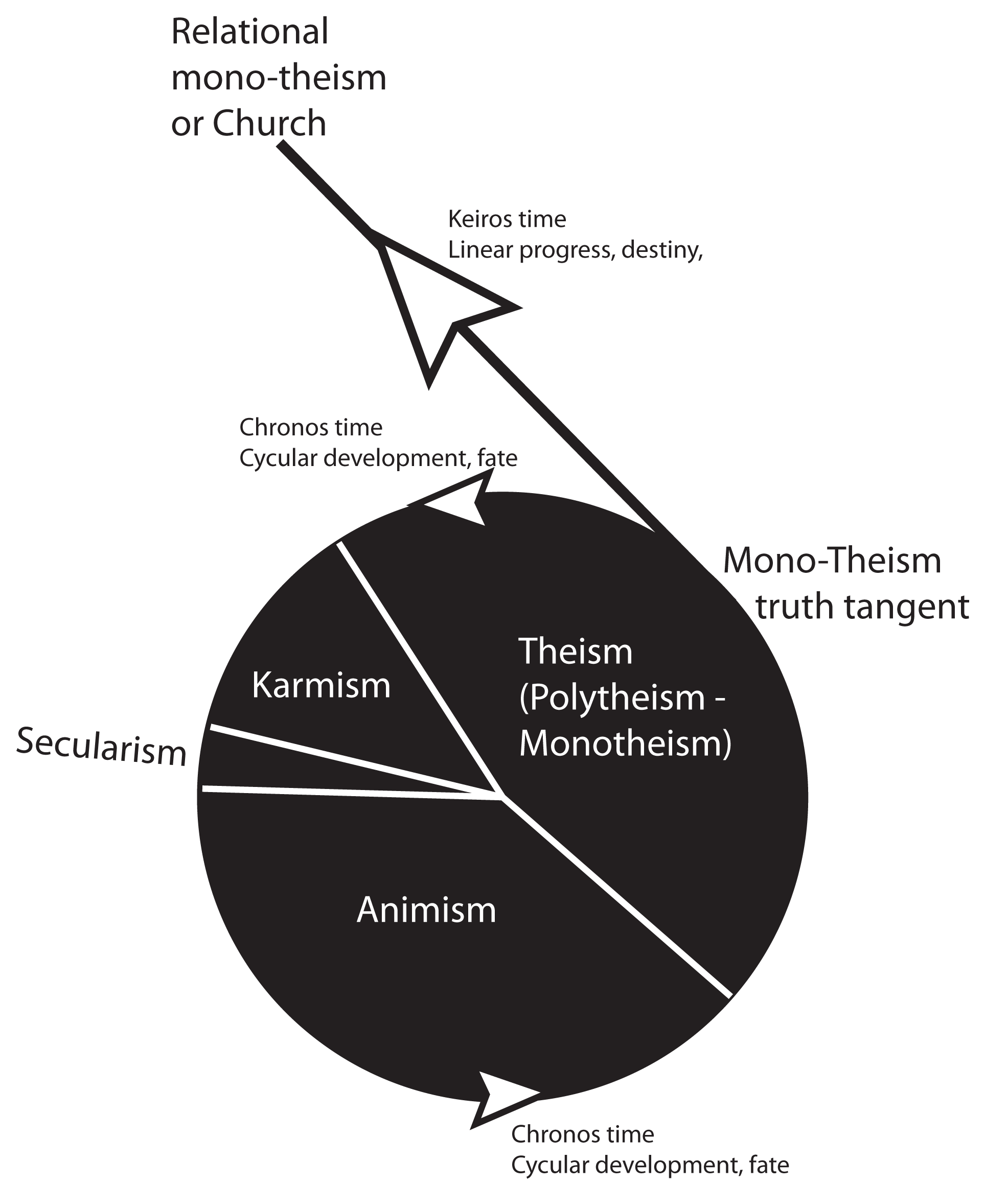
Figure 4. The Human Historical Cycle and Mesotopian Tangent. Viewed from the top, this diagram illustrates the cyclical movement between animism and secularism (solid curve), with the mesotopian ethic represented as a tangent diverging from the cycle (solid line). The tangent, rooted in Biblical faith (out of monotheism), represents a trajectory of progress that is neither utopian nor dystopian.
As visualized in Figure 4, this cyclical pattern is disrupted by the faith-inspired mesotopian tangent. The mesotopian framework does not simply stabilize the cycle but charts a new course—one that avoids the extremes and embraces the creative tension of the "middle ground." While thinkers like Darrow Miller in Discipling Nations have identified the monotheistic worldview as a "stabilizing center" on a continuum of worldviews for societal development,3 the mesotopian perspective sees a large cycle of unregenerate human societies from animism to secularism. The Biblical faith, which underpins the mesotopian ethic, does not merely stabilize this cycle; it provides a radical tangent. This tangent represents a distinct path of progress and refinement in technology, government, and law, achieved precisely by embracing the tensions of the mesotopia rather than seeking refuge in either utopian escape or dystopian resignation. It is through this faith-driven tangent that true optimism emerges—not as a naive denial of evil, but as a robust confidence in God's providence amidst the complexities of human existence.
Engaging Other Theological Frameworks
The mesotopian framework, while distinct, can be further illuminated by comparison with other significant theological perspectives.
Reinhold Niebuhr's Christian Realism: Niebuhr emphasized the pervasive nature of sin, the inherent limits of human idealism, and the pragmatic necessity of pursuing justice through power within a fallen world. His skepticism toward utopian schemes resonates with mesotopia's rejection of idealism and its acknowledgment of humanity's persistent propensity for evil. However, their trajectories diverge. While Niebuhr often focuses on the tragic and ironic aspects of human history, highlighting the perpetual moral ambiguities and limits of human action (often leading to a focus on political ethics), mesotopia posits a unique tangent of progress guided by obedience to divine necessity. Niebuhr's realism explains why the cycle of sin and power persists; mesotopia, while acknowledging this cycle, proposes a framework for how to transcend it through a specific kind of faith-driven and radical obedience that opens possibilities beyond human foresight.
Process Theology: Exemplified by thinkers like Alfred North Whitehead and Charles Hartshorne, Process theology emphasizes God's ongoing involvement with an evolving, dynamic universe. It often pictures God as a persuasive, rather than coercive, influence, actively working with the world's becoming, thus highlighting a dynamic sense of possibility and co-creation. In contrast, mesotopia's core thesis—"Providence precedes potential" and "the necessary creates the possible"—places a stronger emphasis on divine initiative and the revelation of what is necessary, prior to human "potential" as a starting point. While process theology might emphasize a more mutual co-creation of possibility, mesotopia asserts that genuine possibility stems from obedience to God's prescriptive will (e.g., Jesus' instruction to his disciples in Matthew 28:20, "teaching them to obey everything I have commanded you"). This makes the mesotopian framework less anthropocentric and less open-ended in its view of possibility, firmly grounding it in divine command."
The Paradox of Necessity and Possibility
The core of mesotopian faith lies in a profound reordering of the relationship between necessity and possibility. Conventional wisdom often dictates that what is possible precedes what is necessary; we assess our capabilities before committing to a course of action. However, Biblical faith expressed in the mesotopia asserts the inverse: what is truly necessary (as revealed by God) always creates the path for what is possible.
This seemingly inverted logic finds resonance in the thought of Søren Kierkegaard, particularly in his concept of the "teleological suspension of the ethical" in Fear and Trembling.4 For Kierkegaard, Abraham's obedience to God's absurd command to sacrifice Isaac represents a movement of faith beyond the universal ethical. The act, seemingly impossible and ethically reprehensible, becomes possible precisely because it is deemed necessary by God. This mirrors the Christian understanding that whoever seeks to preserve their life will lose it, but whoever loses it for God will find it—a paradoxical truth where release precedes resurrection, and obedience opens possibility. As Marcus Aurelius, in a different context, noted, "What stands in the way becomes the way"—a statement that, while lacking the explicit divine grounding of mesotopian faith, captures the transformative power of embracing necessity.5
The Fatalist says, "It cannot be done, so I am not responsible." Hubris says, "It can be done, so I am entitled to it." But faith—faith says in its mesotopian accent: "If God asks it, then it is both necessary and possible—even if painful."
A contemporary illustration of this principle appears in The Matrix (1999), when Morpheus offers Neo (Mr. Anderson) a single, necessary way out of his predicament at his desk job—via the window cleaner's lift. Neo fails to take this path, and as a result, the range of possibilities is immediately and dramatically reduced. The narrative demonstrates that necessity, when missed, can close off entire branches of possibility, underscoring the mesotopian claim that the necessary opens the possible, not the reverse.6
Engaging Secular Critiques
A secular phenomenologist, such as a follower of Maurice Merleau-Ponty, might argue that prioritizing divine necessity over human possibility risks subordinating lived experience to a theological imperative that appears external to the intersubjective, perceptual structures of human consciousness central to phenomenology. Similarly, a utilitarian, drawing on Jeremy Bentham or John Stuart Mill, might object that grounding ethics in divine necessity ignores measurable outcomes, such as maximizing happiness or minimizing harm, which provide a tangible basis for moral action. They might argue that possibility, defined by human capabilities and consequences, should guide ethical decisions rather than an unverifiable divine will.
In response, the mesotopian framework does not deny the value of lived experience or ethical outcomes but reframes their source and significance, recognizing individual experience as empirical and thus verifiable within consciousness. Against the secular phenomenologist, mesotopian faith asserts that divine necessity, as revealed through scripture and lived obedience (e.g., Abraham’s trust in God’s command), is itself a phenomenon—a tangible reality shaping human consciousness and action, as Hebrews 11:1 suggests. Some may demand an empiricism from outside the faith itself, and, although such a methodology cannot be provided, it is no less an empirical process.
This aligns with phenomenology’s focus on what appears in experience, but it locates the origin of transformative possibility in God’s active Providence rather than human perception alone. Against the utilitarian, mesotopian faith challenges the assumption that human-calculated outcomes exhaust moral value. By prioritizing God’s necessary will—often costly and counterintuitive, as in Abraham’s obedience or Jesus’ call to “lose one’s life” (Matthew 16:25)—a mesotopian Biblical ethic opens possibilities that transcend utilitarian metrics, such as redemptive suffering and grace-enabled transformation. For example, an average parent embodies this mesotopian ethic by sacrificing personal resources and comfort for their children’s well-being, not because it maximizes immediate happiness or equity, but because it responds to a deeper, necessary purpose—akin to divine Providence—that creates possibilities for growth and love beyond calculable outcomes.
These responses position mesotopian faith as a bridge between phenomenological insight and theological conviction, affirming human experience while rooting it in divine purpose.
Providence Precedes Potential: The Theological Grounding
The concept that Providence precedes potential is foundational to mesotopian faith. This asserts that God's active, intentional guidance and provision are not merely reactive to human potential, but are the very source from which genuine potential emerges. Without God's active hand, human possibility, though seemingly boundless, risks becoming ethically chaotic or existentially meaningless.
This argument gains further clarity by drawing from Emmanuel Levinas's work, where ethics begins with the radical obligation presented by the "face of the other," a call that precedes our calculation of what is possible.7 Similarly, Jean-Luc Marion's exploration of "saturated phenomena" suggests that revelation and divine gift (the necessary) precede our conceptual grasp or planning (the possible).8 For both, the given, the commanded, the received—these necessary elements—are the true wellsprings of meaning and action, not the inverse.
Central to this mesotopian understanding of faith is a redefined concept of holiness. As explored in The Subjective God: The Holiness-Purpose Connection, holiness is not synonymous with perfection or sinlessness, but rather signifies a singular dedication to a costly purpose.9 This reorientation of holiness from an intrinsic attribute to a relational posture directly informs how mesotopian faith navigates the tension between necessity and possibility. If God is holy because He is set apart for His purpose, then human holiness likewise means being set apart for God's purposes, regardless of the apparent "possibility" or "ease" of that path. The divine imperative of "the necessary" is not arbitrary but flows from God's own holiness—a holiness defined by His unwavering purpose. This understanding translates directly to the mesotopian condition: human purpose, and thus human action, is defined not by seeking inherent perfection, but by being set apart for God's will within the limitations and ambiguities of earthly existence.10
This perspective challenges both deontology and utilitarianism. Deontology, with its focus on ethical duties or rules (Kant's "Categorical Imperative"), and utilitarianism, which reduces moral value to what is maximally beneficial, both center on what is possible to calculate or construct. Mesotopian faith, however, asserts that "Good" is not what works or what is aesthetically pleasing. "Good" is what God asks—whether it works by human metrics or not. This does not challenge Kierkegaard in Sickness unto Death: "For the fact that God’s will is the possible makes it possible for me to pray; if God’s will were only the necessary, then in the final instance a human being is essentially as speechless as the brutes."11 As in the Abraham example, obedience is only possible if instruction is given, that then becomes the necessary. But obeying—even if it seems to restrict further possibility—opens more possibility. Hebrews 11:19 speaks of Abraham's rational process that he reasoned that God was able even to raise Isaac from the dead if he were to continue on with his obedience to God’s instruction.
Long Obedience in the Same Direction
While Søren Kierkegaard famously described faith as a "leap,"4 the mesotopian perspective reframes this as a series of small, persistent steps—an incremental kaizen of the spirit. True faith is not a single, spectacular act of courage, but a fortitude: the willingness to continue, to "go on" in the new way, even when each step is costly or uncertain. In this light, Christian faith becomes deeply empirical—not in the sense of laboratory verification, but in its observable effects over time. It is lived, tested, and verified in the middle ground of daily choices, relational repair, and long obedience in the same direction12. This is echoed in Jesus' words in John 8: "Go, and sin no more." The imperative is not a dismissal, but an invitation to walk a new path in a new direction—one marked by ongoing, grace-enabled transformation, it is a path both in the direction of Christ and one on which He is present as a traveling companion and guide. In this context, a better English rendering might be: "Come, and sin no more.”13
Addressing Potential Misinterpretations of Mesotopian Faith
To prevent misapplication and clarify its ethical demands, it is crucial to address potential misinterpretations of the mesotopian framework:
1. Fatalism or Passivity: A potential concern is whether "if God's necessity creates possibility," human effort becomes redundant. The mesotopian framework emphatically rejects fatalism and passivity. The "necessary" here refers not to an arbitrary divine fiat, but to obedience to God's stated will. Once God gives instruction, it becomes the necessary course for the faithful disciple. This synthesizes faith with active human participation: the possibilities of the future become dependent not only on God’s specific stated will in the form of instruction, but on human obedience. This dynamic partnership is the inverse of fatalism, demanding engagement rather than passive resignation.
2. Justification for Harmful Acts or Blind Obedience: Another concern is that proclaiming "God's will is necessary" could be invoked to justify cruel or harmful acts, bypassing ethical reasoning. It is indeed possible to delude oneself or others into believing an erroneous perception of "God’s instruction," and history bears witness to such abuses. However, the mesotopian framework does not introduce this problem; it is a perennial risk for any faith claiming divine revelation. What mesotopian faith adds is a crucial corrective: it emphasizes that the truth of the concept and the relationship with God are proven through small, persistent steps—the "long obedience" that begins incrementally. This gradual, lived experience provides a discerning filter, distinguishing genuine divine imperative from human delusion. The example of Abraham, seemingly defying conventional ethics to sacrifice Isaac, highlights this tension: most observers would have concluded he had lost his mind. Yet, mesotopian faith suggests that such radical obedience, while costly, is validated not by immediate ethical consensus, but by its ultimate alignment with divine purpose and resulting revelation of greater possibilities.
3. Diminishment of Human Agency or Freedom: Does this framework diminish human choice or responsibility? Mesotopian faith argues it does not limit human agency, nor does it negate God’s sovereign predestination or foreknowledge. Instead, what truly limits human freedom—and therefore human agency—is disobedience to God’s instruction, precisely because such disobedience restricts the range of genuine possibilities. In this light, obedience becomes the cause, and expanded possibility the effect. While it might appear in certain cases that obedience limits immediate choices (e.g., choice of spouse, or facing imprisonment/execution in a hostile nation), the mesotopian perspective argues that true, ultimate possibility is only unlocked through alignment with divine will. Jesus's own obedience, for instance, seemingly led to his death, yet it ultimately granted him far greater possibilities, both in this world and beyond.
4. Authoritarianism and Abuse of Power: This concern, similar to the justification of harmful acts but specifically related to communal or church leadership, questions whether a leader or group could claim to know "God's necessary will" and impose it on others. Again, mesotopia does not create this risk; it is an enduring challenge within religious communities. However, the mesotopian framework, as presented here, emphasizes individual discernment and personal responsibility in one's obedience. While guidance from community and leaders is vital, the "long obedience in the same direction" is fundamentally an individual journey of discerning and responding to God's specific instructions. This places the onus on the individual's direct partnership with Providence, rather than a hierarchical imposition of "the necessary" that bypasses personal conviction and the internal validation of faith.
Conclusion: The Grit of Mesotopian Faith
Faith, as the phenomenology of the possible, reached by the necessary, provides a robust framework for navigating the complexities of the mesotopia. It is a gritty, ethical faith, one that embraces paradox and thrives in tension. It is a faith that sees humanity's long-term developmental success not as an anomaly against its fallen nature, but as the fruit of a distinct mesotopian trajectory, tangentially deviating from self-defeating historical cycles. As noted earlier, discovery amplifies human intention, either in one direction or the other.
This faith resists the siren calls of both utopian fantasy and dystopian despair. It recognizes that discovery—whether of fire, the wheel, electricity, or artificial intelligence—acts as a catalyst and amplifier of human intention—making us ethically louder.
As C. S. Lewis said, "Good and evil both increase at compound interest. That is why the little decisions you and I make every day are of such infinite importance."14
What it amplifies is human: ingenuity and grace, and also cruelty, fear, and malice. A rational and faithful response to such power demands holding each innovation with optimistic skepticism, asking not only "can we," but "ought we." Yet, those living in the mesotopia are rarely unified enough to pause at the edge of power, often plunging forward, hungry for the control they think it promises.
Ultimately, mesotopian faith is an active, not passive, response to God's call. It is forged in the willingness to embrace the necessary, trusting that our partnership with Providence—obedience to the necessary—will always provide the means for the truly possible. This is the paradoxical yet empowering truth that allows humanity to move forward, not by escaping its fundamental condition, but by living faithfully within it.
Footnotes
¹ Edmund Husserl, Ideas: General Introduction to Pure Phenomenology, trans. W. R. Boyce Gibson (New York: Macmillan, 1931), 51–53; cf. Hebrews 11:1, ESV.
² Henry David Thoreau, Journal, June 15, 1851; Commonly attributed.
3 See Figure 4 and discussion of cyclical models in Darrow Miller, Discipling Nations: The Power of Truth to Transform Cultures (YWAM Publishing, 2001), 45–51, 53–54.
4 Søren Kierkegaard, Fear and Trembling, trans. Alastair Hannay (Penguin Books, 1985), 54–62.
5 Marcus Aurelius, Meditations, trans. Gregory Hays (Modern Library, 2002), Book 5, Section 20.
6 The Matrix, directed by Lana and Lilly Wachowski (Warner Bros., 1999), scene: "The Window Cleaner's Lift."
7 Emmanuel Levinas, Totality and Infinity: An Essay on Exteriority, trans. Alphonso Lingis (Duquesne University Press, 1969), 197–201.
8 Jean-Luc Marion, Being Given: Toward a Phenomenology of Givenness, trans. Jeffrey L. Kosky (Stanford University Press, 2002), 104–110.
9 Alan R. Jones, The Subjective God: The Holiness-Purpose Connection (Independently published, 2015), 12–23.
10 Jones, The Subjective God, 28–35.
11 Søren Kierkegaard, The Sickness Unto Death, trans. Alastair Hannay (London: Penguin Books, 1989), 127.
12 Eugene H. Peterson, A Long Obedience in the Same Direction: Discipleship in an Instant Society (Downers Grove, IL: InterVarsity Press, 2024).
13 John 8:11, with attention to the Greek poreuou (πορεύου), best understood as "continue on this new path."
14 C. S. Lewis, Mere Christianity (New York: Macmillan, 1952), 124.
Bibliography
Aurelius, Marcus. Meditations. Translated by Gregory Hays. Modern Library, 2002.
Jones, Alan R. The Subjective God: The Holiness-Purpose Connection. Independently published, 2015. https://www.amazon.com/Subjective-God-Examining-Singularity-Purpose/dp/B09NL2QH91.
Kierkegaard, Søren. Fear and Trembling. Translated by Alastair Hannay. Penguin Books, 1985.
Kierkegaard, Søren, The Sickness Unto Death, trans. Alastair Hannay. Penguin Books, 1989.
Levinas, Emmanuel. Totality and Infinity: An Essay on Exteriority. Translated by Alphonso Lingis. Duquesne University Press, 1969.
Lewis, C. S. Mere Christianity. New York: Macmillan, 1952.
Marion, Jean-Luc. Being Given: Toward a Phenomenology of Givenness. Translated by Jeffrey L. Kosky. Stanford University Press, 2002.
Niebuhr, Reinhold. Moral Man and Immoral Society: A Study in Ethics and Politics. New York: Charles Scribner's Sons, 1932.
The Matrix. Directed by Lana and Lilly Wachowski. Warner Bros., 1999.
Miller, Darrow. Discipling Nations: The Power of Truth to Transform Cultures. YWAM Publishing, 2001.
Peterson, Eugene H. A Long Obedience in the Same Direction: Discipleship in an Instant Society. Downers Grove, IL: InterVarsity Press, 2024.
Whitehead, Alfred North. Process and Reality: An Essay in Cosmology. Corrected edition, edited by David Ray Griffin and Donald W. Sherburne. New York: Free Press, 1978.
Whitehead, Alfred North. Process and Reality: An Essay in Cosmology. Corrected edition, edited by David Ray Griffin and Donald W. Sherburne. New York: Free Press, 1978.
Hartshorne, Charles. The Divine Relativity: A Social Conception of God. New Haven: Yale University Press, 1948.
© Alan Jones