
A Dialogue Between Scientific and Relational Empiricism.
“Trust is a biological reaction to the belief that someone has our best interest at heart.” — Simon Sinek
The coffee shop buzzed, but the atmosphere at their table was awkward, the kind of stillness that precedes an intellectual conflict. Professor Gustave Le Rouge, a sharp-edged figure known for his rigorous empiricism, pushed a graph on cognitive bias aside and fixed his attention on Peter Mickreys, the student whose challenge had interrupted his analysis. Le Rouge took a deep, controlled breath, managing his frustration. Beside him, two graduate students leaned forward: Lucia, focused on analytic philosophy, and Brian, a cognitive science enthusiast.
“‘Does God exist?’ Seriously, Peter?” Le Rouge began, his voice calm but the underlying tension palpable. “Let’s be precise. As a philosopher, I defer to the best available epistemology: Scientific Empiricism. It deals in the observable, the replicable, the falsifiable. Since God cannot be produced in a lab, observed on demand, or disproven—He is, epistemologically speaking, irrelevant to fact.”
“I see the scientific boundary, Professor, but I find the lane too narrow; it’s not very satisfying, is it?” Peter countered. “You’ve drawn a clean line: science deals in objective fact, and belief deals in personal opinion. My argument is that this line is false. I submit that even your most ‘objective facts’ are fundamentally rooted in something messy, human, and personal: relationship.”
“Nonsense,” snapped Brian. “The fact that atmospheric CO2 levels are rising requires no relationship. It requires measurement equipment. The facts stand alone.”
“They stand alone for you because you trust the authority that gave you the numbers,” Peter replied. “But let’s start closer to a universally accepted truth. We all agree that empirical evidence—evidence based on observation or experience—is the gold standard, correct?”
“Correct,” Le Rouge affirmed. “But that evidence must be publicly verifiable to be scientific truth.”
“Precisely,” Peter said. “And that brings me to my first challenge: Scientifically, objectively, how could any of you prove that your spouse, your partner, or a parent loves you?”
Lucia spoke up. “That’s a category error, Peter. We can measure oxytocin spikes, fMRI activity, and actions that imply care. But the feeling of love is not a truth claim accessible to external verification because it is subjective.”
“Precisely, Lucia,” Peter said, smiling. “You admit that the publicly verifiable, scientific data is not proof of love. Yet, all three of you know that you are loved by someone, right? What is your proof?”
Le Rouge answered deliberately. “Our proof is the accumulated evidence of consistent actions. My wife making sacrifices, repeated kindnesses—it’s experiential evidence certainly. It is repeatable, but only for me. It is private; I couldn’t subject it to a double-blind trial.”
“Ah, but is it empirical?” asked Peter. “Is it based on your direct observation, and is it replicable? You have observed that pattern of care over and over. It is personal, it is experiential, and it is repeatable within the context of your relationship; therefore it is empirical.” The others sat thinking for a while, their expressions a mix of concession and suspicion. “I propose that we have no choice but to define this kind of personal empiricism as a second, valid form of knowing. Do you agree?”
The Domain of Relational Empiricism
“I guess so,” answered Le Rouge slowly, “but that says nothing about the scientific method. What are you getting at?”
“I’m just thinking through the perception of science along with the method,” said Peter. “You accepted that your 'Relational Empirical' evidence is important to you personally, Professor. I contend it’s not a lower order of knowledge; it addresses the highest order of human questions.”
“Let’s be precise, as you say Professor. You’re familiar, I’m sure, with Descartes’ project: using pure doubt to find the unshakeable foundation of knowledge. What was the only thing he couldn't doubt?”
Lucia responded quickly, “Cogito, ergo sum. ‘I think, therefore I am.’ One knows one’s own existence via introspection, not external, public proof.”
“Exactly. The foundational fact of your entire world—that you exist—is proven by a private, subjective, unshareable experience. The most fundamental truth is Relationally Empirical. And let’s move past Descartes to Sartre,” Peter pressed. “Sartre argued that existence precedes essence. Meaning isn't found in a lab; it’s created. Where is it created?”
Professor Le Rouge finished the thought. “Meaning, love, purpose—these are created in the lived experience, in relationship with the world and with others.”
“Thank you, Professor. So, when I ask, ‘Does God exist?’ or ‘Does my life have purpose?’ I am asking an existential, relational question.”
Peter summarized, "Scientific Empiricism answers how and what about the observable world. But Relational Empiricism answers who and why—and does so with empirical certainty, but only within the relationship itself.” Peter waited a few moments before continuing, “So, do we agree? Is Relationally Empirical a valid and necessary epistemology that answers facts about the world that Scientific Empiricism cannot touch? And it is not ‘lower.’ It is merely different.”
The heads all nodded in agreement.
“So far, we’ve mapped two empirical domains: one public, one personal. But I assert that their boundary is linguistic rather than ontological. That boundary is also porous. Relational data can enter science when it becomes publicly replicable, and scientific findings ultimately return to the realm of relational trust. We ought to acknowledge this reciprocity.” Peter concluded.
Professor Le Rouge conceded, “OK, I agree that your ‘Relational Empirical’ domain is valid for answering existential truths. But you still haven't shown that it contains the scientific domain. The facts about physics and chemistry remain objective; they are utterly independent of my personal trust.”
The Danger of the "Objective" Lie
“Do they?” asked Peter skeptically. “I think it’s really worth testing that particular assertion. We have defined Relational Empirical and Scientific Empirical. But I want to challenge the semantics of that second one. You called it ‘objective.’”
“And it is objective,” interjected Brian. “It is designed to be free of human bias, even unconscious bias by double-blind placebo. A chemical reaction doesn’t care about the scientist’s feelings.”
“The chemical reaction does not, Brian, but the acceptance of the data absolutely does,” Peter replied. “You accept scientific facts based on the published work of countless scientists whom you have never met. The vast majority of the public, the government, and even other scientists must rely entirely on a system of human honor and relationship to accept that final result. Ladyman and Chakravartty observe that science describes reality through relational structures, not through isolated facts. And Simon Sinek said, ‘Trust is a biological reaction to the belief that someone has our best interest at heart.’ What happens when that belief is violated?”
“You get fraud,” Professor Le Rouge murmured, “scientific fraud, in this case. But so much of that is blown out of proportion.”
“Perhaps, but my point is it happens, it can happen.” Peter countered, “ We know scientists can and do lie for prestige, to hide mistakes, and for profit. So tell me, Professor, if the acceptance of the vast majority of scientific facts requires blind trust in the integrity, honor, and honesty of the scientific community—a trust that is demonstrably violated at times—how can you label the conclusion ‘objective’? When the foundation is trust, the structure cannot be purely objective. It is, in fact, inherently relational, is it not?” He waited a few moments before continuing, “There’s another kind of science fraud we seldom speak about, the studies science can do, but doesn’t.”
“What do you mean?” asked Lucia.
Peter explained, “There are a lot of potentials, especially in healthcare, that never get a gold-standard study , a randomized controlled trial. Initial studies show promise, but no one cares to study further because there’s only money in what’s patentable. So billions go into ALS drug trials, for example, while natural unpatentable treatments rot in the “shows promise” purgatory—not for lack of signal, but lack of IP.
“Well that’s hardly fraud,” countered Le Rouge.
“Isn’t it?” said Peter quickly turning to him, “maybe it isn’t, but it can hardly be called "Objective" Professor Le Rouge can it?” Peter waited, there was anger in his eyes, and no one said anything. After a long, awkward pause Peter continued, calmly, efficiently. “It’s not objective by anyone’s standard, not even the scientifically religious. When the absence of a study is weaponized as proof of absence—‘no RCTs, therefore bunk’—that’s the argument from ignorance fallacy—institutionalized anti-science.”
“Now wait a minute,” said Le Rouge, halfheartedly; but Peter interrupted him.
“No professor,” he said sharply, “we’ve been waiting since the enlightenment, and now Big Pharma is the biggest lobbying group in Washington. It’s time we were honest. The scientific method is “Scientific.” but it’s not objective by any stretch of the imagination. I’m not claiming that any relational method is, by the way. I am countering the claim that science is. And here’s why I think it’s also a kind of fraud. Scientists, politicians, and the media prey on the argument from ignorance fallacy and they do so willingly. They are quite happy to go along with society’s condemnation of people who point out that just because something isn’t studied doesn't mean it’s untrue. They do it with a single sentence: ‘there are no studies showing what you say to be true.’ Bam, just like that, you’re branded a science denier. despite the fact that this is precisely the way discovery moves forward, and refusing to follow evidence and claiming science doctrine is precisely the way science dies and religions work… science has become the state religion.” There was silence at the table again. Peter let it simmer.
At last he continued, “If the most certain fact—that you are loved—is proven relationally, and the most fundamental fact—that you exist—is proven introspectively… why then do we feel the need to qualify scientific empiricism as ‘objective’ except to try and give it a much needed definition boost in society? What we end up doing is claiming that science is the new, improved way, and you’d better tow the line if you know what’s good for you. Those are bully tactics, those are the words of a dictator; and, personally, I want nothing to do with them, and I think that scientists, in general, ought to abandon that tack immediately.
My logic holds,” he asserted, “the term ‘objective’ is misleading when applied to the social institution of science as opposed to other relational methods. But that does not make science invalid, even the skeptics are aware of what science has accomplished. But there’s an attempted science coup underway by the bureaucrats, and we must not be complicit—in fact, we ought to resist it, for the sake of science itself if not for the sake of other human beings, even for the integrity of our own ethic.
Einstein’s Relativity, Quantum Mechanics, and Gravity—all our deepest scientific theories—show that reality is ultimately about relationships, not solitary things. Epistemology is just the same: before we ask what is, we must ask whom we can trust. Besides,” he grinned, “when people like each other, don’t we say they have chemistry?”
The Inversion: Science as a Subset of Trust
Brian and Lucia smiled, but Le Rouge was still frowning.
“The system, my dear boy,” said Le Rouge somewhat condescendingly, “is designed to catch errors through adversarial replication, competing interests, true scientific skepticism (as opposed to wild conspiracy theories), and transparent methodology. Individual scientists may be fallible, but the system itself is designed to catch errors. That's what makes it different from other methods—whether you call them relational or not—it has built-in safeguards.”
"Does it?” retorted Peter, “If the system is specifically engineered for self-correction, why did it take a journalist to expose the Alzheimer's research fraud after 16 years? Why did the replication crisis in psychology persist for over a decade despite everyone knowing about it? Why are people like John Money, and Malthus—who’s theories have been debunked—still so influential? Why did the fluoride example require a court—not scientists—to force regulatory honesty? If science is designed to self-correct, but requires lawsuits, whistleblowers, and journalists to actually correct it then isn't that proof that the relational structures—funding, prestige, career incentives—override the methodological safeguards? Safeguards are necessary, every method has them, Professor, but every safeguard is only as trustworthy as the people applying it. When you say that science is designed to catch errors, well then why doesn’t it? I'm not making a case that it never does, but if it's designed specifically for that function—your claim—then it ought to at least almost, always, right?”
“That,” exclaimed Le Rouge forcefully, “is precisely what it does do, almost always!”
He regretted the words immediately, “does the scientific method catch errors almost always?” he asked himself. “Yes, surely it does,” but he wasn’t sure.
“With all due respect Professor,” said Peter slowly, “I think you’ll find the data does not support that assertion.” He opened his laptop as he searched around on it a bit while saying slowly, “Let me… show… you… something.” He spun the laptop round to reveal a chart of 10 landmark studies showing replication rates, publication bias, fraud detection lag times, conflicts of interest, and peer review failures. All the inefficiencies of self-correction in the real world scientific method, with detection relying on external pressures, like whistleblowers and lawsuits, rather on than built-in processes.
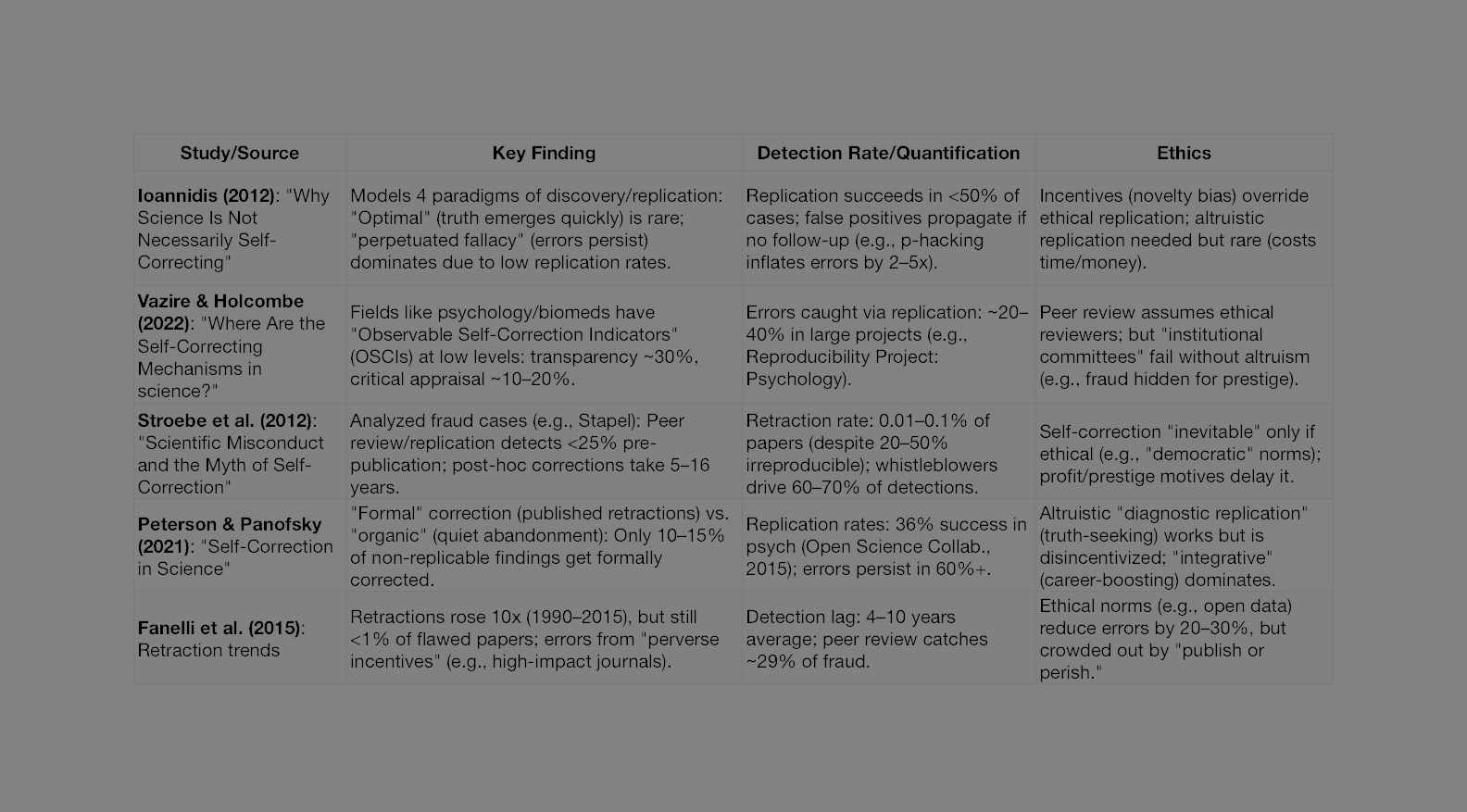
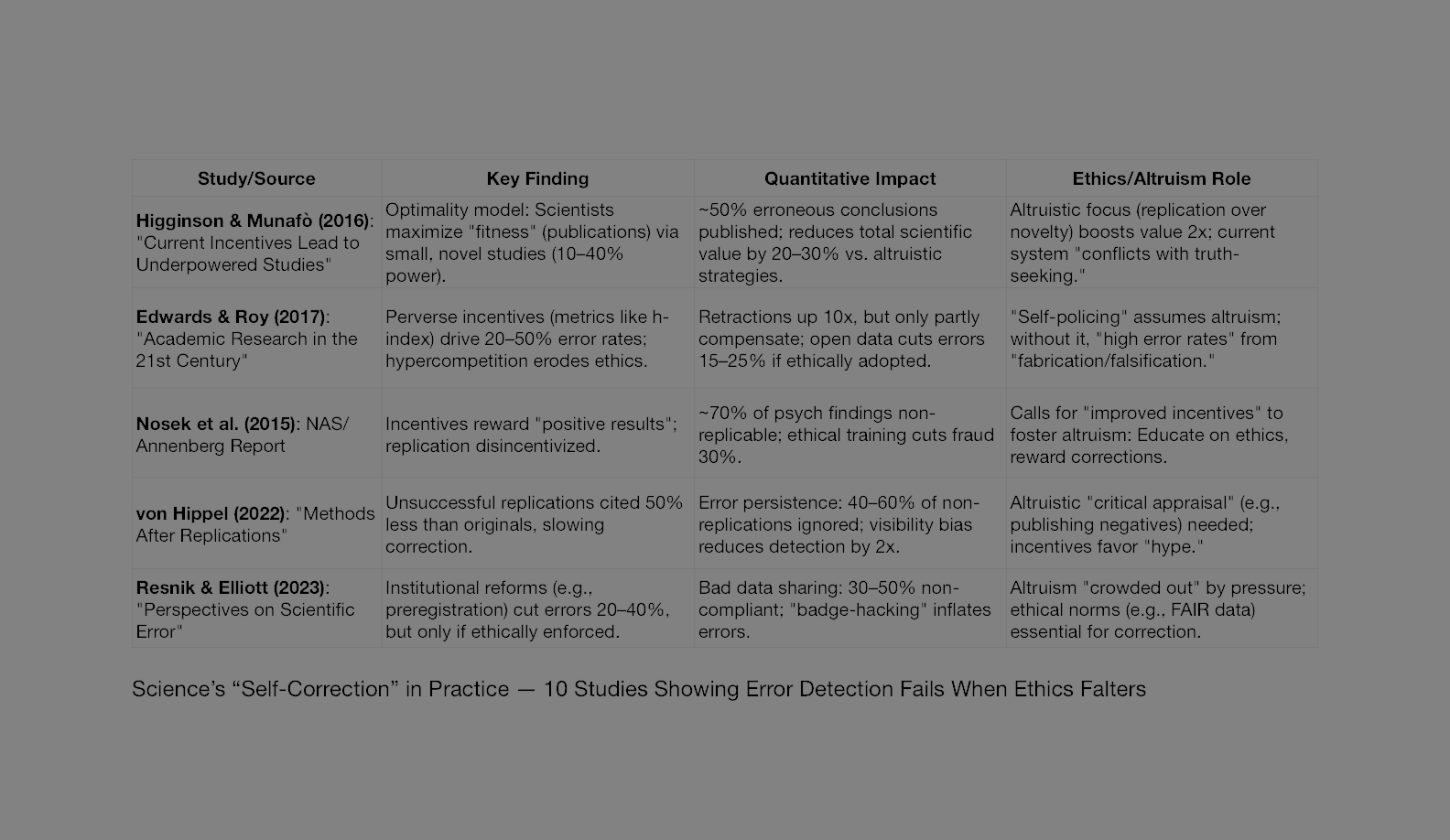
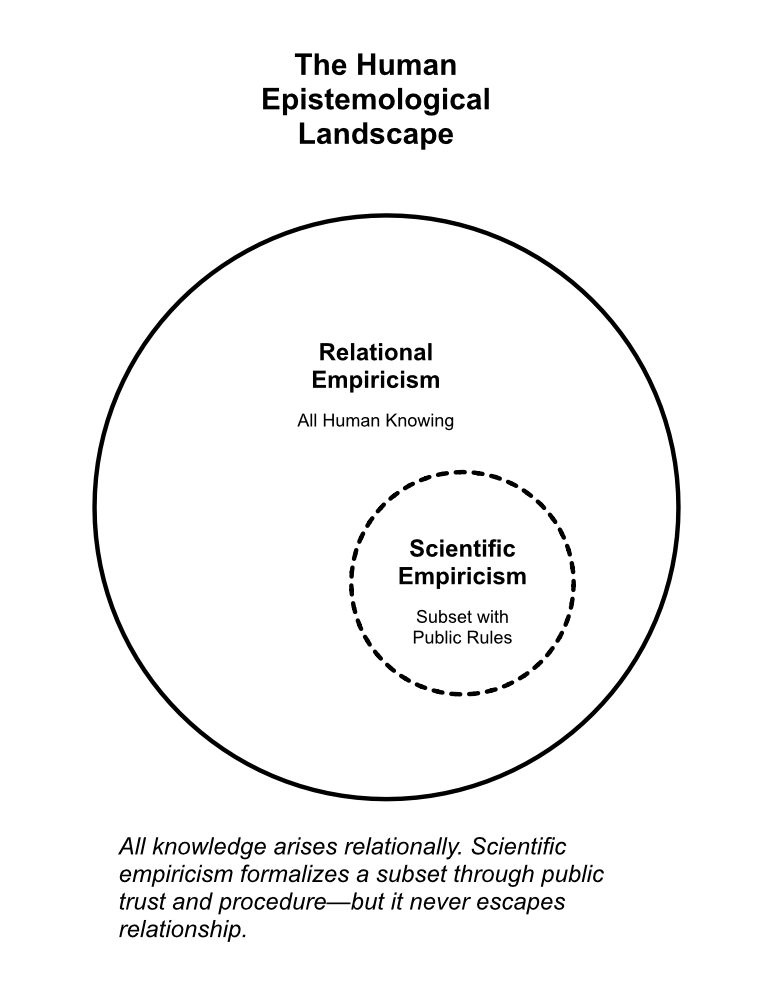
Peter shut the laptop and flipped the page of his notebook. “Look,” he said, “I’m not trying to throw the baby out with the bathwater, peer review and replication work fine when motives are altruistically—in fact they excel, but they falter under ethical pressure. We must deal with the bathwater, right? There is a lot of it! The scientific method isn’t infallible just because it has achieved great things.” He quickly sketched a simple ven diagram. “And I believe I have adequately shown that Scientific Empirical is not separate. It is a subset of Relational Empirical.”
“I’m not convinced,” Lucia challenged, folding her arms as she leaned back in her chair.
Peter continued. “Since no scientist verifies every experiment in every field, we all—including you, Professor—accept results on blind trust in strangers’ integrity. Despite knowing they lie for grants, tenure, Pharma stock options, infidelity, tax evasion, and every other human failing. We know this because humans lie—all of them! Therefore Scientific Empiricism, by definition, is a specialized case of Relational Empiricism, isn’t it?”
There was silence.
“Your argument is that the relationship of trust is the prerequisite for accepting the data,” Le Rouge summarized. “Therefore, the scientific process must be contained within the broader human act of relational knowing. All science is a form of relational knowing.”
“Exactly,” Peter confirmed, leaning back in his chair. “Scientific Empiricism is just Relational Empiricism with extra rules—good rules, well conceived rules for public replication and falsification. But it never escapes relationship. Also, the boundary between the two isn’t impermeable—relational data can enter science when publicly replicated, and scientific findings return to relational trust.”
Peter continued, his voice serious. “Ok, now can you see how dangerous it is to label the scientific empirical as ‘objective’? When it is, in fact, a subset of the relationally empirical. Especially when the government can, and does, enforce scientific conclusions, and when public perception and dialogue can shame and cancel skeptics.”
“This is precisely what the story of The Emperor’s New Clothes is about. The system breaks not because the data is wrong, but because the relational trust can be, and has been, weaponized.”
Peter pulled out a chart from his notes.
“Look at the Fluoride Paradigm. For six decades, the ‘objective consensus’ was enforced. The warnings of personal experience were dismissed by shaming skeptics citing the ‘objective consensus.’ It took a new relational structure—the legal system—to force accountability in 2024. The relational failure of the regulatory and scientific bodies necessitated a relational correction by the courts. The 2024 ruling didn’t debunk fluoride’s efficacy with a lab test. It exposed a relational failure: regulators buried inconvenient data for decades. The ‘objective consensus’ was enforced by shaming skeptics, not evidence. Courts—another relational system—had to override it.” *
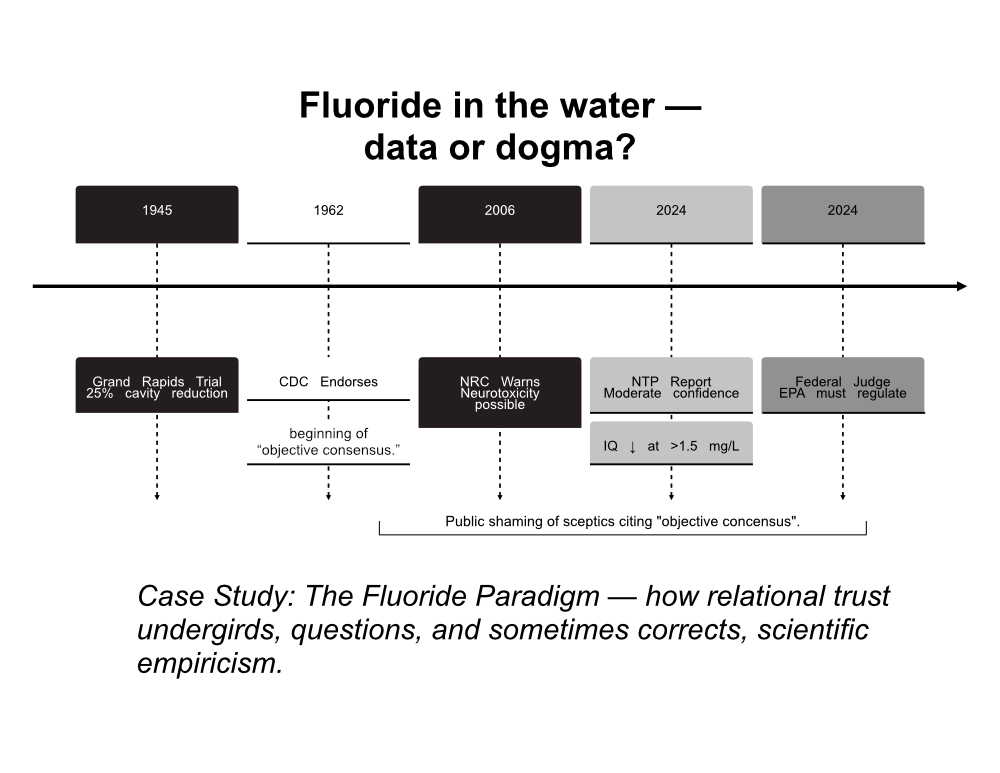
Professor Le Rouge picked up the timeline and studied it. “You argue well, Peter, you’re relentless about assumptions. But a good rhetorical style isn’t proof, and you’re still young, you still have that post-grad shine and sharpness. But I do see one thing in your favor: By calling science relational, you demand accountability. You force transparency. You admit the human vulnerability to profit and prestige. You don’t seem to be against science.”
“Against science? No, I am not!” asserted Peter. “I am very much for science, but not as a religion. I am more in favor of science than much of the scientific community, at least enough to call out fraud, bullying, and inconsistencies. I have not argued from authority, nor have I resorted to ad hominem.” He raised an accusing eyebrow at Le Rouge who quickly glanced away. Peter continued, “We must be strict about our language. We must never write off other empirical assertions just because they aren’t scientific. And we must understand that all the incredible power of science rests entirely on the fragile, human promise of relational honesty. All knowledge is relational.”
—All knowledge is relational. Science flourishes when it admits this: when it resists dogma, welcomes the skeptic, and returns to earned trust.
*Food & Water Watch v. EPA (Nov 2024)—court found EPA ignored neurotoxicity data under TSCA.
Easter Eggs:
- Professor Gustave Le Rouge: (Anagram: Religious Atheist) Represents rigorous Scientific Empiricism and analytic skepticism.
- Peter Mickreys: (Anagram: Merry Skeptic) Represents Relational Empiricism and philosophical synthesis.