
A speculative essay
What are the odds of this?
In fifth-century Greece, four of the most consequential minds in Western philosophy, natural science, and mathematics appeared in direct generational succession and in the same region, Athens. Plato the student of Socrates. Aristotle the student of Plato. Alexander the student of Aristotle.
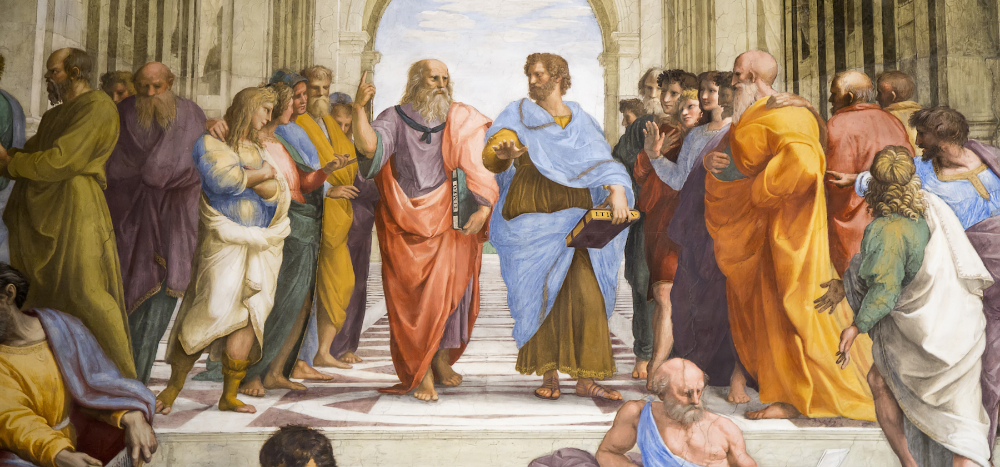
The probability of that chain occurring by chance is like that of Da Vinci, Picasso, Van Gogh, and Warhol being born in close enough succession and location that each one tutored the next. Or it’s like that of Hippocrates, Newton, Einstein, and Hawking similarly in close succession and location. It didn't happen with the artists. It didn't happen with the scientists. But it happened with those four philosophers — and the civilization that they shaped now dominates the world, as Daniel predicted it would in his Ram and the Goat in chapter eight of his prophetic writing.
Now, I’m not saying great artists and scientists don’t follow each other, the impressionists, for example, or Albert Einstein and Niels Bohr. But the four from Athens were not of the same movement, they were foundational, multidisciplinary foundation layers of what we call the Western world. They laid the foundations of art, philosophy, writing, poetry, epistemology, mathematics, biology, and all the sciences including the scientific method itself.
This improbability is not central, or even necessary to this thesis. Given what we know about intellectual ‘clumping’ in great cities, some clustering is to be expected—but this specific, four-deep mentor–student chain in one city, laying the multi-disciplinary foundations of Western thought, is improbable enough that assigning it to a purely natural cause just seems inadequate to me. At the very least, it warrants asking whether an unseen spiritual agency is at work. This level of improbability—at the very least—invites the question: What if it wasn't chance?
Daniel 7 describes four beasts coming out of the sea onto dry land for judgement before the Ancient of Days—lion, bear, leopard, and a fourth creature too terrible for an earthly-beast metaphor. Biblical scholarship has long mapped these as allegories describing the empires of Babylon, Medo-Persia, Greece, and Rome. Michael Heiser's work on the divine council adds another layer: these beasts also represent spiritual principalities, rebellious cosmic beings whose fates become entangled with the human empires they influence. They come out of the sea, which is a long established allegory of human and earthly chaos going right back to Genesis 1.
This essay proposes something further—that these four beasts are not merely historical and spiritual. I propose here that they are also archetypes of an ongoing rebellion, and their most durable expression—one designed to resist a borderless ‘temple’—is governmental, spiritual, and philosophical. The lion's legacy is both Nebuchadnezzar's palace and it is Socratic skepticism. The bear's legacy is both Persian opulence and Platonic idealism. The leopard's legacy is Alexander's conquests and it is Aristotle's empirical materialism, the seedbed of secularism. And the terrifying fourth beast's legacy is not only Roman law, civic government and Pax Romana. It is also Stoicism—the philosophy of duty, resilience, honor, human sovereignty that has threaded itself through Western civilization from Marcus Aurelius to George Washington's Society of the Cincinnati to the self-help shelf of every airport bookstore.
The beasts didn't die with their empires, they seem to have a fatal head wound that seems to heal in rather predictable cycles (Revelation 13:3). They went underground. They began to manifest as generational ideas.
The mappings require some explanation, because they're upstream—more diagnostically causal—of the formal philosophical schools.
I am not making a claim that Socrates was a Skeptic, that Plato was a Hedonist, that Aristotle was a Cynic, or that Alexander was a Stoic in any textbook sense. I am making a claim about ingredients, not the final dishes served. Socrates' relentless questioning of every certainty—his refusal to accept received truth—contains the spiritual DNA of skepticism, the corrosive doubt that ultimately turns on God himself in its later, degenerated forms. In Plato's metaphysical realism there is an elevation of "higher" forms of pleasure in the Symposium, his justification of pederasty as producing children of the mind rather than mere children of the body, is hedonism in idealist clothing—it is indulgence dressed as philosophy. Aristotle's empiricism, his pivot from Plato's ideal forms to the measurable world contains the seedbed of a worldview that eventually reaches its terminus in Nietzsche's announcement that God is dead. And Alexander’s imperial cosmopolis—disciplined, world-conquering though culturally inquisitive—lived the proto-Stoic ethos that Rome later codified into law and Europe and America later inherited and adopted as secular civic virtue. Received, ironically, as the same sort of received truth that Socrates rejected.
These are spiritual genealogies, They are generational genealogies, not academic taxonomies.
Interestingly, a similar civilizational cycle appears in The Republic, where Plato describes regimes descending from aristocracy to timocracy, oligarchy, and democratic tyranny (where the majority is the tyrant). Plato attributes this pattern to generational shifts in character. Yet what he observed politically may represent something deeper: the recurring spiritual archetypes that Daniel’s vision portrays as beasts rising from the sea.
Across widely separated traditions, human civilization repeatedly appears to organize itself into four recurring archetypes. Greek medicine described four temperaments; classical philosophy described cycles of political character; modern sociology observes generational archetypes; Scripture itself repeatedly uses fourfold imagery—the four winds of heaven, the four corners of the earth, and the four living creatures surrounding the throne: The prophet Daniel saw four beasts rising from the sea. Even the throne visions of Ezekiel, Isaiah, and Revelation portray four living creatures symbolizing the full spectrum of created order.
These parallels do not prove a single underlying structure, but they suggest that human history may move through recognizable psychological and spiritual patterns. What Daniel reveals prophetically, philosophers and historians may simply be noticing from within the system itself. In that sense, the recurring cycle may even function as an epistemic framework for humanity’s knowledge of good and evil—moral insight emerging through repeated civilizational experiments and spiritual influence.
Strauss and Howe, in The Fourth Turning, describe a recurring four-generation cycle they call the saeculum—roughly 80–100 years—in which four generational archetypes rotate in sequence: Artist, Prophet, Nomad, Hero. Their framework is secular and sociological. But the pattern it describes may be older than sociology itself. It is definitely Western, and can only be traced in other cultures in sectors that have not been Westernized.
Borrowing the Strauss Howe pattern, this essay proposes a verbal reframing and renaming. At this point in history, the beasts are not just empires or philosophies; they are also generational scripts. Instead of the diagnostic Artist, Prophet, Nomad, Hero; call the archetypes what they actually do to a civilization across their cycle: Skeptic, Hedonist, Cynic, Stoic respectively. One generation, born in a crisis, questions everything. The next indulges in all the freedom that questioning creates. The third, born into the awakening, becomes disillusioned by those indulgences, and develops a cynical, practical, and material mindset. The fourth, exhausted by cynicism, imposes order through duty and discipline as we try to manage our way toward another crisis. Then the wheel turns again.
In our current examples:
Silent = Skeptic, Baby Boomer = Hedonist, Gen X = Cynic, Millennial = Stoic, and Gen Z = Skeptic again.
The enemies of Yahweh, if we take Daniel and Heiser seriously—which I very highly recommend we do—are not stupid. They don't fight only a territory (Deuteronomy 32) battle anymore. The territory battle rages still on a human and spiritual level; but the main fight on planet earth is generational; cycles with cycles. The battleground shifted—from the borders of kingdoms with stone temples in fortified cities to the interior of human minds and the portable body-as-a-temple of the Holy Spirit.
In the ancient world, myths often pictured gods and spirits riding through human affairs—the Norse Wild Hunt and similar traditions—as unseen, cyclical visitations shaping events from behind the visible. The Wild Hunt was not merely a story about chaos; it was an intuition of spiritual agency. What those traditions preserved as myth, Daniel names as prophecy.
Paul names it plainly in 1 Corinthians 6:19: the temple of God is no longer a building in Jerusalem. It is the body of the believer. Portable. Borderless. Translatable into every language and culture on earth. The main difference between a tabernacle and the New Testament temple is that the New Testament temple is far easier to get through customs with the Gospel and the presence of God!
As G. K. Chesterton observed, heresies are not new ideas but old truths gone mad; the Skeptic–Hedonist–Cynic–Stoic cycle may simply be the civilizational rhythm by which those partial truths repeatedly detach from the whole and dominate an age.
That is the target God had in mind when he designed a nation of priests ministering to the world (Exodus 19:6, 1 Peter 2:9).
There is historical evidence that this cycle may be disrupted.
Strauss and Howe note a conspicuous anomaly in European history: the interval between Waterloo and V-J Day runs 130 years—significantly longer than the usual 80–100 year range. They have no satisfying explanation for it. This essay proposes one.
The abolitionist movement, driven by William Wilberforce and the Clapham Group, achieved something historically unprecedented that may help explain this anomaly: a unified collaboration between Christians in government, in business, and the Church, motivated by a moral conviction, an ethic so deep that it bent the arc of Western history. First the slave trade then slavery were not merely abolished in England. The usual generational cycle was disrupted. The Stoic-to-Skeptic reset was delayed by a generation, a crisis—suffered in France—was averted in England by a nation of priests. This disruption rippled into working conditions in the early Industrial Revolution, into economic competition with France, into the moral architecture of an entire civilization. It functioned like a positive ‘Upside Down’.
The same four that stride through Daniel 7 also seem to stride through Western history as generational masks. That disruption has a shape. It looks like Yahweh's sevenfold cycles—Sabbath, Jubilee, God’s structuring of time against patterns of three, four, six, and twelve (which fit humans into neat controllable mega-cycles). The enemy works in fours. God works in sevens to preserve God-given human agency. The reason a seven-day week resists clean integration into a thirty-day month and a twelve-month year is not an accident of history. It is an intentional structural disruption, a kairos built into the fabric of time. Whatever the human contingencies, Scripture’s sevenfold structuring of sacred time functions as a disruption to neat imperial calendrical control.
The last words of the Old Testament are both a promise and a warning. Malachi 4:5–6: God will send Elijah to turn the hearts of the fathers to their children, and the children to their fathers—or else there will be consequences. That is not God giving a threat, but a warning, The cost of fitting into the enemy’s cycles is the loss of human freedom on earth. The New Testament opens with the fulfillment of God’s promise: John the Baptist, in the spirit and power of Elijah, comes to disrupt cycles of generational control and renew generational bonds. The New Testament emerges, among other things, as a ministry of generational healing, strengthening, and training for offensive warfare against which the gates of hell will not prevail.
Which means the Church's mandate is not merely spiritual in the private sense. It is generationally apostolic—believers who are sent to their generational neighbors, tasked with mending the divides that the four-cycle system exploits and the crises they perpetuate. The Skeptic generation and the Stoic generation do not naturally understand each other. That estrangement is not incidental. It is the point.
The Apostolic Mandate is to reach for "the unity of the faith" while maintaining "the unity of the Spirit." (Ephesians 4:3&13).
Daniel 7 Beast | Empire | Overriding Principality | Philosophy | Philosophical Archetype Figure | Generational Archetype |
Lion | Babylon | Pride | Skepticism | Socrates | Skeptic |
Bear | Medo-Persia | Indulgence | Hedonism | Plato | Hedonist |
Leopard | Greece | Anarchy | Cynicism | Aristotle | Cynic |
Fourth | Rome | Control | Stoicism | Alexander | Stoic |
Figure 1 - A mapping of the archetypes. The last column, Generational Archetypes, includes Howe & Strauss' nomenclature for the 4 generations in The 4th Turning (Artist, Prophet, Nomad, Hero), and the current generations for reference. Note: The Philosophical Archetype Figures are not the authors of these philosophies but their most concentrated historical sequential expression; the philosophy precedes them as a spiritual condition. They are symptomatic rather than intentional cause.
None of this, of course, is proven. This essay is, as advertised, speculative cartography—an attempt to draw a map of territory that may or may not exist in the form described. We are not presented at birth by Utopia, but we are presented with utopian ideals and we have enough hubris to believe that “our generation will put it right,” as Phil Collins once said—all rather ironic when one considers the origin of the concept of utopia. We are also not presented with the dystopia we are inclined to fear. We are presented with a rising Mesotopia. Small, steady, long-term improvements.
The Mesotopian map has internal coherence. And once you see the Skeptic-Hedonist-Cynic-Stoic wheel turning through Western history—through generations, through institutions, through the ideological air we breathe—it becomes very difficult to unsee.
The church that recognizes the wheel is at least free to step off it.
The author acknowledges the foundational work of Michael Heiser (The Unseen Realm, 2015), William Strauss and Neil Howe (The Fourth Turning, 1997), and Thomas Cahill (The Gifts of the Jews, 1998), whose frameworks this essay freely adapts for its own speculative purposes.