
A critique of Nietzsche's Twilight of the Idols: How to Philosophize with a Hammer.
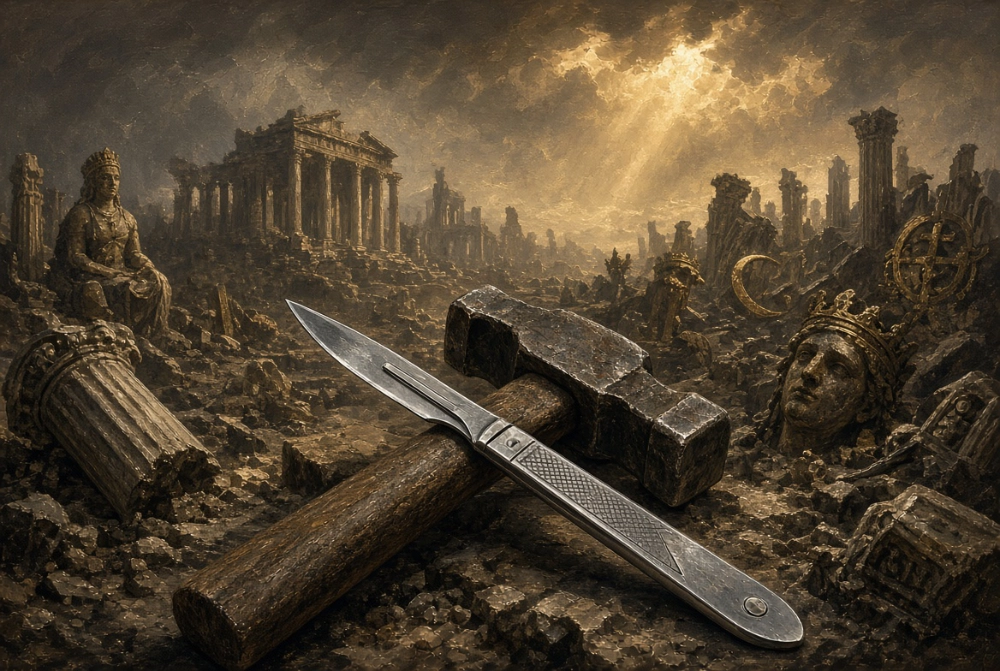
A philosopher with a hammer
In 1889 the German philosopher Friedrich Nietzsche published Götzen-Dämmerung, Twilight of the Idols, with the subtitle: How to Philosophize with a Hammer. The book examines a world full of idols, the big ideas and traditions that people worship without ever questioning them. The philosopher, according to Nietzsche, is to walk up to each one and tap it with a hammer. If it rings hollow, it's a fake.
He wasn't wrong about that, there are plenty of fakes. There is a lot of transactional religion that is just power in a costume—what I call tall hats and smoking handbags—and a lot of what we call morality is just a way to look good while being cruel, virtue signaling or a trained toxic victimhood. Nietzsche was going after overt hypocrisy, and he was exceptionally good at spotting counterfeits.
But the hammer is only one tool, it’s not a complete toolset, and it’s a blunt instrument at that.
Three problems with doing philosophy with a hammer
Firstly, it is far easier to break than it is to build. Anyone can smash a window, but it takes a master to build a house. Nietzsche clears a lot of ground, but then he doesn’t have a whole lot to put on it. Nietzsche is a critic, a cynic; precisely the kind that Teddy Roosevelt’s Man in the Arena addresses. It’s part of a speech he delivered as a critique of the critic, if you haven’t read it it’s worth a read. Here’s a small part: “It is not the critic who counts.” Diagnostics have some value, but they don’t rebuild, and they don’t heal.
Second, a hammer can't tell a forgery from a foundation. There are a lot of solid things that can make a hollow sound. Diagnosis is not that easy. There are fake gods, and a real God can be hidden (Isa 45:15). What looks random to us could equally be providence.
Third, we tend to be biased. We aren’t very consistent at subjecting our idols and sacred cows to the same tests we’re eager to subject others to. Nietzsche never shows why his “will to power” is not an idol. Most critics end up standing on something they never tested.
You may know the old saying: if all you have is a hammer, everything looks like a nail. It’s a slightly different metaphor but it proves the same point, hammers are extremely specific tools, even when they’re not used for demolition. You cannot do everything with a hammer, and philosophy is a broad task, extremely broad. It is perhaps the broadest of all tasks!
Everybody wants to be a doctor
Nietzsche didn't only call himself a diagnoser with a hammer, he also called himself a physician of culture. He thought Western civilization was sick, and he wasn’t just going to diagnose it, but also to cure it. But Nietzsche seldom cures anything, he seems to operate with the wrong tool and the wrong anthropology.
And Nietzsche was also not unique as critic of society. The Bible is uniquely honest about its heroes. The difference between the philosophy of Nietzsche and that of the Bible is the surgeon, and what he believes about the patient.
Nietzsche cuts out the weak and hollow. Scripture removes what is false so that we, the patient, may live.
Biblical surgery is the one kind of cutting that is also a kind of healing. The incision serves the beginnings of the life-saving repair.
The scalpel
The Bible also keeps a hammer handy. The prophet Jeremiah says God's word is “like a hammer that breaks the rock in pieces” (Jeremiah 23:29), and Jesus flipped tables in the temple. But the picture Scripture returns to again and again is far closer to an operating room than a demolition site.
Hebrews 4:12 says the word of God is sharper than any two-edged sword and can reach between the thoughts and intentions of the heart. That is a precision unavailable even to the most devastating philosopher. The Greek word for "sharper" here means “cutting.” Through the prophet Ezekiel, God says he’s going to give us a heart transplant, “I will remove the heart of stone from your flesh and give you a heart of flesh” (Ezekiel 36:26).
So, who is doing the surgery? It is not the philosopher, we aren’t much good at diagnosing each other, even less diagnosing ourselves. We also cannot be our own surgeon; no one can perform delicate procedures on themselves while under an anesthetic. If we are the patient—and it seems we all agree on that—then the only competent diagnostician and surgeon, according to the Bible, is God. We may have all kinds of opinion on the condition of the universe around us, making our own unqualified assertions, but on what grounds are we to accept our own opinions? The only part we play is to lie still and say what King David said: “Search me, O God, and know my heart! Try me and know my thoughts! And see if there be any grievous way in me, and lead me in the way everlasting!" (Psalm 139:23-24, ESV).
I call this a sindectomy: the surgery in which God removes what is killing us so that we can live. And we all need one.
It's the searcher who is lost
Most of us picture philosophy as a search. We go out looking for truth the way you might go looking for your keys.
But I noticed something about searching for truth: Anyone honestly searching for the truth eventually finds that it is the searcher, not the truth, who is lost.1
In Galatians 4:9 Paul says, “now that you have come to know God,” and then corrects himself in mid-sentence: “or rather to be known by God.” Knowing flips into being known. Blaise Pascal pictured God saying that we only seek God because we have already found Him.
Nietzsche’s posture was to test everything, but who tests the tester? Socrates roamed Athens questioning people, searching for truth. The true surgeon is not the one being tested, He’s the one testing you, and His motive is not criticism, it’s love.
The trouble with Nietzsche’s philosophy with a hammer is that a broken mind is ill equipped to figure out that it's broken. One thing it cannot diagnose is itself. But it can be diagnosed and it can be operated on, and afterward it can see more clearly than before.
Agalethia: the love of the truth
Philosophy comes to us through Greek: philo is “love” or “friendship”, sophia is “wisdom” or “knowledge.” Philosophy pictures the thinking human reaching toward something far away; a bold adventurer charting undiscovered truth.
I think that the Bible is doing something else, and I've come up with a word for it: agalethia.
It combines agapē, the Greek word for “self-giving love,” with alētheia, for truth. The agalethia idea is found in 2 Thessalonians 2:10 where Paul says that people perish because they “did not receive the love of the truth.” In Ephesians 4:15 he tells us to be “truthing in love.” And Jesus did not claim to merely “have the truth.” He said instead, “I am the truth” (John 14:6, ESV).
In John 8:32 Jesus didn't say that you will know the truth and the truth will prove you wrong. He said that you will know the truth and the truth will set you free; and in John 3:17 He said that God sent his Son not to condemn the world, but that the world through him might be saved.
Truth isn't an object we pursue, like wisdom. Truth is a Person who pursues us.
And this isn't a cold or distant kind of affection. When the Old Testament was translated into Greek, the translators used the word agapē all through the Song of Songs, the most passionate love poem in the Bible. “I am sick with love,” says the lover (Song 2:5). The love of the truth is not mere polite interest, it’s being swept up by someone.
Compare that to the way the philosopher Plato describes love, eros, in his dialogue the Symposium. There, love is a ladder. You start with a beautiful body, then a beautiful soul, then beautiful ideas, until you reach beauty itself, and you leave other people behind on the lower rungs. In the Song of Songs, the opposite happens, the one you love is the whole point, and you hold on and don't let go (Song of Songs 3:4).
Hold the forceps
Someone might object that all this makes us sound like patients asleep on the table under a heavy anesthetic. Is philosophy really just something done to us?
Not exactly; Paul says, “Continue to work out your salvation with fear and trembling, for it is God who works in you” (Philippians 2:12-13, NIV). Both these things are true, God does the surgery, and then we get to participate. We’re asked to, “hold the forceps” while we’re being stitched up. Agalethia surgery is done with little anesthetic, which makes it extremely painful, but necessarily so, because our participation is required. We aren't able to do our own surgery, but we must put into practice what is healed as it is healed. Even Jesus refused an alcoholic sip dying on the cross, perhaps because He knew that he needed full control of His faculties. The surgery requires the patient to remain awake precisely because the new heart must begin to beat in the old body.
The servants at the wedding feast at Cana in John 2 didn't turn the water into wine. But the wine would not have come out of those jars if they had not filled them with water. Good thinking is like that: faithful labor, followed by astonishment at what God does with it.
Two ways to live
Nietzsche asks what we're able to break, Scripture asks what God is able to heal. There is a place for both of those questions. Some things should be broken down. But there is deeper work that the hammer alone can’t accomplish.
The first question keeps us in charge, but builds little to nothing and heals even less. The second one puts us in the subjective position. That is a far scarier, and bolder, philosophy; it requires a trust that turns mere philosophy—an affinity with wisdom—into agalethia—a deep love of truth. It's also the only way anyone ever gets a new heart.
What am I willing to let be healed? What am I needing to let be healed? Are those two the same things?
What is the one thing you'd keep defending, even if you knew it wasn’t true?
Reference
1. Jones, Alan R. The Subjective God. 2015. (Get it on Amazon or listen on Spotify)