
The Enlightenment, Don Quixote, and John Locke’s Cartesian dream
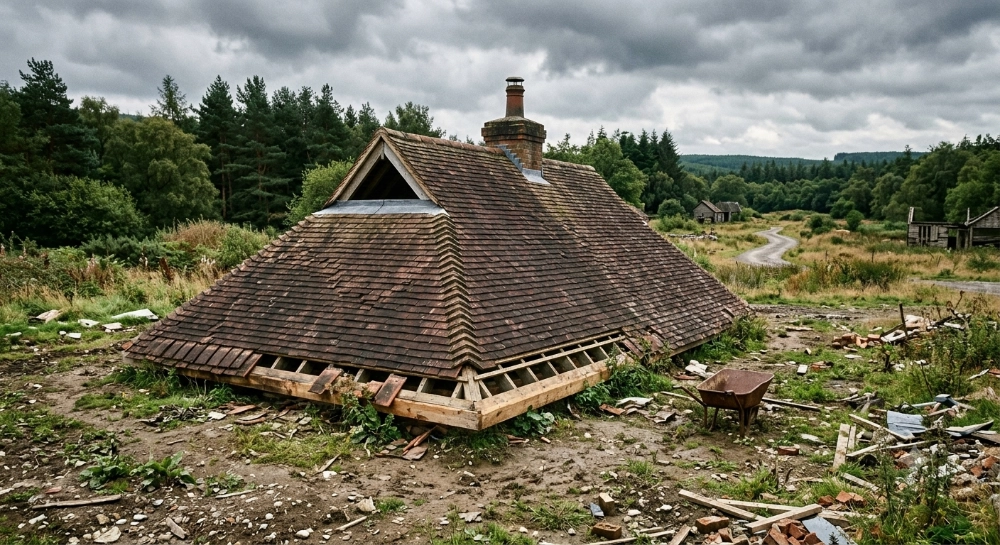
Noddy's House
In Enid Blyton's Toytown, Noddy wants to build a house. He decides to start with the roof. Big Ears—Toytown's Gandalf/Dumbledore/Kenobi—tells him plainly that one cannot start with the roof when building a house. The walls come first. The foundation before that. Noddy, full of enthusiasm and empty of critical thinking and patience, is bewildered but blunders ahead.
The roof, of course, sits on the ground. Ideal for snakes, rodents, and spiders; but unfit for toys, or men. It is, of course, not a house.
It’s amazing what we can draw out of children’s stories and fairytales. This is not a story about stupidity, Noddy is not stupid. He is eager and he is willfully ignorant—which are far more dangerous, because eagerness and willful ignorance do not listen. Big Ears is not a tyrant, he purveys hard-won knowledge that cost to gain. The wisdom he carries is inherited, and he knows it while Noddy dismisses it. It didn't cost him anything.
Every generation eventually builds a roof and calls it a house because we are quick to dismiss the foundation and walls we were given. The Enlightenment built the grandest roof-on-the-ground in Western history. They are still charging admission and humans don’t fit under it without crawling.
Every generation eventually builds a roof and calls it a house because they are quick to dismiss the foundation and walls they were given.
Don Quixote
Miguel de Cervantes published Don Quixote in early 17th century Spain.
Don Quixote dons a rusted suit of armor, mounts a broken-down horse, and rides out to right the wrongs of the world. He is sincere, he is brave, and he is completely wrong about what world he is living in. He might as well be singing Lennon’s Imagine.
The windmills he chooses to attack in his delusion are not evil giants. Everyone can see this except Quixote.
What Cervantes understood—and what makes this the most important novel ever written—is that Don Quixote is not attacking the real past. He is fleeing into a fictitious version of it to avoid the present and to avoid doing something truly significant. The windmills he charges are magnificently symbolic of the current technology in his world. The pre-industrial machine world of the Middle Ages—wind and water power smelters, mills, and blacksmiths. He sees Middle Age technological advance as what’s wrong with the world. The knight he tries to be is a historically evaporated figure. He has constructed an alternative reality from a library of bad maps, they have become his identity. To admit the windmill is a windmill and that more machines are coming, is to cease to be his new identity, the self-significant Don Quixote. Hero of the reality he has crafted for himself, which is no reality at all.
The armor on his back, the lance in his hand, the stirrups on his horse—these are products of Medieval craftsmanship. The real civilization he has romanticized into fantasy—with its advances and its terrors—is the same one that forged his weapons. He is charging at the products of the world he imagines he is defending, having turned that world into a fairy tale too thin to actually live in.
He has Sancho Panza—loyal, grounded, sane, his ‘Big Ears’—who knows they are windmills and follows along anyway. That is Sancho's tragedy: the faithful pragmatist yoked to the sincere lunatic, unable to leave, unable to give correction because, like Noddy, Don Quixote is utterly blind to the possibility of his error.
Cervantes wrote this thirty years before the beginning of the Enlightenment, with the Industrial Revolution starting shortly after. The social unconscious produced the diagnosis before the disease reached full expression. This is precisely what great literature does. It predicts the outcomes of the folly of enthusiasm and willful ignorance—whether it’s Noddy or Don Quixote.
Don Quixote is not attacking the real past. He is fleeing into a fictitious version of it to avoid the present and to avoid doing something truly significant.
The Children of the Blessing
The Medieval world was not simply the dark pit of social despair that many in the Enlightenment required it to be.
It was the age of the great cathedrals—applied mathematics in stone. It was the age of the university—Paris, Oxford, Bologna. It was the age of wind and water power, of horizontal looms and heavy plows, of mechanical clocks and eyeglasses and smelting with bellows. Pre-industrial machine prototyping. The windmill itself is Medieval engineering.
Above all, it was the age that handed Western civilization its most foundational conviction: that the universe is rational and investigable, because a rational God made it and called it good. Without that prior, science has no warrant. The Enlightenment's entire program of rational inquiry is Medieval theology's grandchild—a grandchild who tilted at the family windmill and called it liberation. The Enlightenment is Don Quixote, it is Noddy tearing down and rebuilding, starting with the roof. Full of wonderful fresh thinking, and also full of itself, its own self-importance.
Of course the Middle Ages were also filled with social deformities and horrors—many of them Christian. As has been the case in the Post-modern world—as in the Industrial Revolution and has been in every civilization. Come to think of it Post-modern social horrors are arguably worse than Medieval ones.
And I would be ironically remiss if I didn’t also acknowledge the miraculous benefits of the Enlightenment—and I do mean miraculous rather literally. Life expectancy, literacy, material conditions all benefit from Enlightenment endeavors, as the Enlightenment benefitted from Medieval ones. I am addressing in this article, the materialist conclusions of the Enlightenment, particularly those drawn out of Locke’s philosophy.
The children of every blessing are always quick to overlook the blessing and emphasize the excess. They did not pay for it, they did not watch it being built, and they are yet to make their grand mistakes. They see only the shadow the tall tower casts, and they are fastidious, meticulous, relentless about toppling it. They do not examine the foundations before they begin, that would slow them down. Every generation wants to take the midnight train going anywhere.
Their turn is coming to try and build something truly good, with idealistic eyes they say things like, “let’s topple these evil windmills”—unwilling to acknowledge the debt they owe to their existence—“let’s start with the roof”—willfully ignorant of the realities of the task they have set for themselves. But, they are eager!
The children of every blessing are always quick to overlook the blessing and emphasize the excess.
The Roof on the Ground
René Descartes locked himself in a room and stripped away everything he imagined that he could doubt until he found his bedrock: Cogito, I think. Then he leapt to his conclusion like a man of faith: Cogito ergo sum. I think, therefore I am. The sovereign self, alone, certain, his imagined starting point of all knowledge.
Here’s a flaw he never answered: what if the thinking self thinks I am not? Can the sovereign self generate its own negation? No it cannot, the self cannot even choose to become a self, it arrives having given no consent, already formed, and is further formed by language and relationship. And Descartes has no resource to answer these, because he evacuated the very language, relationship, tradition, givenness, all that makes the self coherent in the first place. He found the cogito by subtracting everything that makes thinking possible. (more on this here)
John Locke took Descartes’ sovereign self and gave it rights. Natural rights—life, liberty, property—self-evident to reason, requiring no theological ground. He also gave the self a tabula rasa: a blank slate, arriving empty, writing its own content through thought and experience. The self is sovereign. The self is self-authoring. The self needs no Big Ears, no Sancho Panza of foregone wisdom. These are foundational products of the Enlightenment, and they are a roof without walls or a foundation.
Locke personally could not quite cut the cord—he still invoked the Creator as a kind of backstop. But the structure of his argument runs without one. His readers received the structure willingly and quietly dropped the theological term as redundant. The conclusion was inevitable, even if Locke did not intend it: if rights are self-evident to reason alone, and reason belongs to the sovereign self, then rights originate wherever reason originates. In a secular age, that can only mean the state, for all practical purposes. The theorist may well imagine the self detached from rule and relationship, the bureaucrat has no such delusions and eagerly endorsed the power of state to endow rights—and, of course, to take them away.
It is disheartening to hear a modern congressman in the USA say that rights come from the government. This is not Locke's position, Locke held that rights are “natural”. However, it is predictably what his argument produces, under the ministrations of the educated—carefully, systematically—Locke’s “natural rights” become those imputed by the state. Riffing off the Cartesian cogito, Locke believed epistemology to be written onto the self as a tabula rasa—a blank slate. It was supposed to liberate from inherited dogma. But no-one is a blank slate, he is made blank by what he unlearns—and then is re-indoctrinated—by an Enlightenment education.
The Enlightenment's great trick was convincing men that receiving its brand new tradition was, finally, thinking for themselves. Never mind that it taught, as first priority, to build a house for men and to start with the roof. As second priority to topple the Medieval windmills, to evacuate the wisdom of the past.
Both Descartes and Locke built the roof before the walls, and taught others to follow in their Enlightened footsteps. The roof sits on the ground—fit for snakes, reptiles, and spiders, but not for men. They called it a house and charged admission. The West has been living in it ever since, wondering why it is so cold and their backs are so bent.
The theorist may well imagine the self detached from rule and relationship, the bureaucrat has no such delusions
The Counter-Thesis
The American founders, of course, read Locke. They read him very carefully, which is more than most of his inheritors managed.
They took his political vocabulary—rights, liberty, consent of the governed—and embedded it in an established metaphysical frame, one that the Enlightenment was attempting to topple. Instead of Locke’s “natural rights” in the Declaration, they put the roof on the wall: “endowed by their Creator”—this is not decorative deism. It is load-bearing architecture. It anchors itself right outside the social contract, which means outside of revision by consensus, which means outside the reach of any congressman with a pen or bureaucrat with an agency acronym.
James Madison's entire constitutional structure presupposes the opposite of the tabula rasa. Checks and balances, separation of powers, federalism, enumerated powers—you only need these if human nature is fallen, not blank and self-perfectible. Federalist 51 is the anti-Locke written in Lockean vocabulary. The founders took the roof and loudly built it onto the Medieval walls and foundation. That structure—equally imperfect—was itself, built on earlier Christian foundations. The common load bearing truth is that there is obviously a Creator. Their epistemology was, “For what can be known about God is plain to them, because God has shown it to them.” (Romans 1:19).
The Founders built a hybrid success, anchoring an Enlightenment roof onto older, sturdier walls. We see this across the Anglosphere—in a common-law tradition that protected the entrepreneur, the moral fire of the Abolitionist movement, and the Protestant emphasis on conscience. Madison’s Federalist 51 is, at its core, intentional anti-tabula-rasa rhetorical engineering. It is a structure built on Calvinist realism about human nature, knowing that because men are not angels, they cannot be trusted with a blank slate.
These, and others, produced durable institutions that delivered prosperity and relative stability. Societies that kept more inherited wisdom and mediating institutions—like family and church—fared far better than those that fully evacuated them.
The Founders built a hybrid success, anchoring an Enlightenment roof onto older, sturdier walls.
The Rubble
C.S. Lewis saw the terminus of Locke’s and Descartes’ logic clearly. In The Abolition of Man he traced the logic to its end: excise objective value, and you do not liberate man—you abolish him. The self that is sovereign over all external authority becomes subject to whoever controls the sovereign self's formation. The blank slate is not freedom. It is a monstrification.
Quixote charged the windmill with borrowed armor and a romanticized fantasy, unaware that the civilization he'd turned into fiction was the very one that made his lance. The Enlightenment charged the Medieval world with borrowed logic and a romanticized future, unaware that the rational universe it was so confident in was a Medieval theological inheritance.
Excise objective value, and you do not liberate man—you abolish him.
It’s a tramedy—a comedy that keeps becoming a tragedy the longer it runs. It’s not a problem of cynicism. Don Quixote, the Enlightenment, even Noddy were endearing in their enthusiasm. This is the most important thing to understand; they were tragically sincere.
Quixote genuinely believed in the evil giants of a bygone era. Enlightened philosophies genuinely believed in the perfectible man. Noddy genuinely believed he could start with the roof. And social theorists genuinely believe that human beings can be entirely self-directed into wholeness, disconnected from nature or history, if given enough social engineering.
The sincerity makes the collapse more heartbreaking, but it does not dispel the willful ignorance. It is the ultimate expression of Locke’s blank slate—the delusion that we can write whatever we want onto human nature without the whole structure collapsing. We all are subject to the Dunning Kruger effect, not through lack of rationality, but through lack of humility.
And when it goes wrong, it goes catastrophically wrong—not because of the tools modernity provided, but because of the vision that wielded them.
What is sorely lacking today is stoic responsibility for the ripple effect that academia has on society. Many academic ripples become social tsunamis long after their faulty premises have been abandoned by their proponents. And they rarely possess the self-awareness or integrity to take responsibility for their devastation. Marx, John Money, John Dewey, Rousseau, Margaret Sanger, Francis Galton (Darwin's cousin), are a few examples. Ideas like radical autonomy, sovereign self, state as rights-giver, eugenics, have failed spectacularly: The French Revolution, the terror of Napoleon, the various 19th/20th-century socialist experiments—whose ideologies we keep resurrecting ideologically, cultural revolutions that treat culture as fully malleable.
What is sorely lacking today is stoic responsibility for the ripple effect that academia has on society.
Locke’s roof is still on the ground.
Every generation wants to take the midnight train going anywhere. The question is whether anyone has the patience—and the humility—to ask where it ends up before they board. That answer is in the minds of those who have tried, and failed before. Not in the minds of the theorists, the shooting stars. Ideas are very necessary, but ideas have consequences. It does not hurt to ask whether we’ve tried some of these things before, and what the outcome was, all it takes is humility.