
A critique of NT Wright’s creatio ex vetere.

Why You Should Read This
Eschatological presuppositions are not abstract theological luxuries—they form part of the load-bearing walls of every Christian’s practical life and every church’s missional identity. What you believe about the end shapes what you do in the middle.
This essay argues that the two dominant positions on new creation—creatio ex nihilo and N.T. Wright’s creatio ex vetere—while each correcting genuine errors, both fail to honor the epistemological boundary John draws in 1 John 3:2: “what we will be has not yet been revealed.”
A third position is proposed—creatio ex promissione, creation from promise—grounded in the Abrahamic logic of Romans 4 and the resurrection of Jesus as its first instance.
From there the essay introduces a three-theater framework for the cosmic conflict—spiritual, physical, and ethical/judicial—arguing that Wright’s framework cannot account for the judicial war still to be fought, the Divine Council architecture of Scripture, or the church’s forensic vocation as witness in God’s own legal defense.
Finally, it dismantles the popular misidentification of human legal systems as justice, distinguishing fairness from Justice proper—singular, eschatological, katargeō-level, and still to come.
You may have heard it said that eschatology and Divine Council themes are merely academic; this article intends to show that if you get eschatology wrong—or misunderstand the spiritual realm—you will either abandon the world or try to save it by the wrong means.
What you believe about the end shapes what you do in the middle.
I. The Two Positions and What They Get Right
The question of what God will do with creation at the end has generated two dominant answers in contemporary theology.
The first is creatio ex nihilo — creation out of nothing. It is a recreation, starting over from scratch. It is the view that the “new creation” of man, earth, and heaven is a radical discontinuity, a divine act that leaves the present order behind entirely. God annihilates what is and re-makes what will be from nothing. In this reading, the resurrection of the body is something of an awkward exception rather than a paradigm, reconciled somewhat by the idea that the new creation will resemble the old, if only cosmetically.
This reading preserves divine sovereignty, guards against any romanticization of the fallen order, and takes seriously the apocalyptic fire language of eschatology that runs through both Testaments. If creation is comprehensively corrupted, perhaps only a comprehensive new beginning will do. But it brings into question God’s ‘all in all’ victory. Project creation 1.0 could be seen as a failure, and surely God does not fail.
The second is N.T. Wright's creatio ex vetere — creation from what exists. Wright argues that new creation is the transformation and renewal of the present order rather than its replacement. The resurrection body of Jesus is his paradigm: it is the same body that entered the tomb, now resurrected, glorified, and transformed, not a substitute.
Matter is dignified. Continuity of identity is preserved. The earth is not discarded but redeemed. Wright ’s reading of Romans 8 and Revelation 21–22 identifies the new creation not as an escape from the cosmos but as its renewal.
Both positions, then, are doing genuine theology. Both are aimed at correcting real errors. Wright, in particular, forces the Church out of its somewhat Reformed slumber. There is work to be done, the Bride of Christ is not a princess on a divan being fanned while servants feed her grapes. She is an army waging war against unrighteousness. The Kingdom suffers violence. The telos, for each of us, is clearly defined here, on earth. Telos is not perfection, it is maturity, the race run to its completion. May it be on earth as it is in heaven.
There is much victory in Wright’s theology. The question is whether either of these views—or both together—tells the full story.
I don’t think they do. Wright rights some wrongs, but also Wright writes some wrongs, if he would pardon my putting it that way. Both of these views are seated in an existing view of the world.
CS Lewis puts it very well in Mere Christianity, “If you read history you will find that the Christians who did most for the present world were precisely those who thought most of the next. It is since Christians have largely ceased to think of the other world that they have become so ineffective in this.”
Raphael's The School of Athens, is painted with Plato and Aristotle engaged in intense debate in the center of the frame. Plato is pointing up, to the ideal, Aristotle gestures at the horizontal, the here and now. This is the same argument they are having philosophically, but framed theologically. And it’s a false dichotomy, because both are not just good, theologically both are necessary. To LOVE the Lord your God with your heart, soul and strength is precisely to LOVE your neighbor as yourself. The second is like it.1
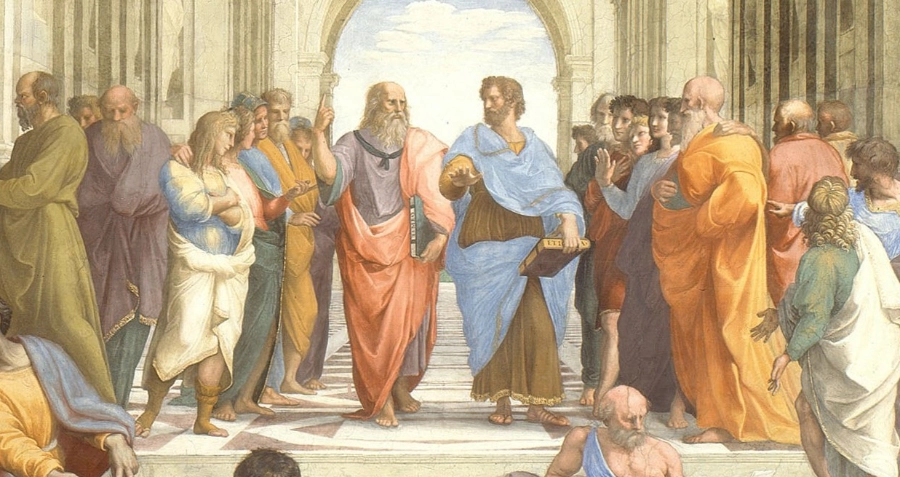
Raphael's The School of Athens
The Bride of Christ is not a princess on a divan being fanned while servants feed her grapes. She is an army waging war against unrighteousness.
II. What Both Get Wrong
The shortcomings of ex nihilo in its eschatological form are well-documented by Wright and others. Paul's seed-and-body analogy in 1 Corinthians 15 establishes continuity of identity across radical transformation—the seed that goes in is genuinely related to the body that comes out resurrected. The body that dies is resurrected and enhanced, it is not biblically described as made from scratch. Annihilation-and-replacement cannot account for this without evacuating resurrection of its meaning.
But Wright's ex vetere has shortcomings of its own, and they are a little subtler.
Creatio ex vetere—creation from what exists—is reasoned forward from presently accessible categories rather than strictly exegeted from the texts themselves. It takes what exists—matter, identity, continuity, the created order—and projects a transformed version of it into the eschatological space. Wright uses a remodel metaphor—God does not demolish the house, he renovates it. But a remodel presupposes that the existing structure is fundamentally sound. You keep what works and upgrade what doesn't. You reason from what is, toward what will be.
John explicitly closes that reasoning down. "What we will be has not yet been revealed." (1 John 3:2)
The yet is not incidental, it’s not a gap to be filled by theological inference (Wright’s framework uses the resurrection of Jesus and key Pauline texts to project a transformed-but-continuous vision of the future that goes beyond what the texts themselves disclose). John sets a deliberate epistemological and eschatological boundary, a hidden unknown that belongs to a coming revelation. John does not say what we will be is hard to describe—he says it has not been revealed. It’s not that the category is difficult, it is withheld. It may also be difficult, we don’t know and God isn’t telling… yet.
Wright's ex vetere framework crosses this boundary. It reasons itself into the hidden unknown from present categories. It offers a picture of new creation—transformed matter, renewed cosmos, renovated earth—that exceeds what revelation has actually disclosed. In doing so I suggest that Wright commits the same error he correctly identifies in others: he over-realizes his eschatology, not by collapsing the kingdom into the present, but by collapsing the form of the future into the categories available to him now.
Paul says so explicitly: "What you sow is not the body that is to be." (1 Cor. 15:37) There is continuity of identity, likely there is continuity of form, but even if so, we simply don’t know to what extent. The seed cannot reason its way toward the body from what it knows of the seed. Only the intervening act of God produces what the seed could never have predicted.
Wright’s framework does not fully reckon with this.
John does not say what we will be is hard to describe—he says it has not been revealed. It’s not that the category is difficult, it is withheld.
III. Creatio Ex Promissione: From What God Has Spoken Forward, and From What We Do Not Know Yet
If neither ex nihilo nor ex vetere is adequate, a third position is required—not as a compromise between them but as a genuinely different frame.
Creatio ex promissione: creation from promise.
The paradigm is Abraham. Paul's treatment in Romans 4 is precise: Abraham believed in "the God who gives life to the dead and calls into existence the things that do not exist." (Rom. 4:17) The logic here is not ex nihilo in the bare philosophical sense—God re-making from absolute nothing—nor is it ex vetere in the same sense—God transforming what already exists. It is something categorically different: God speaking a future into existence that has no material precedent—although it has a present seed—and cannot be extrapolated from present conditions. “Not yet been revealed” at least implies that it cannot be a perfected more-of-the-same. Sarah's womb is not the raw material from which Isaac is constructed. It is, humanly speaking, the obstacle—or one of them, Abraham being the other “good as dead.”
What God promises does not emerge on the basis of what exists (even if it emerges from what exists, and we don’t know to what extent it does). What we do know is that it arrives in spite of what exists. Jesus is the prototype of Abraham’s paradigm, he was resurrected, miraculously, in spite of being dead, not because of being dead, and not through being dead. Jesus’ resurrection was on the basis of God’s power and God’s promise, they turned what was dead into seed of resurrection.
We can’t assert that new creation is remade from nothing, neither that it is renovated from what is. It is called forth by divine word directed forward—it necessarily exceeds the categories, though not the identity, of that from which it came.
Sarah's womb is not the raw material from which Isaac is constructed. It is, humanly speaking, the obstacle—or one of them, Abraham being the other “good as dead.”
Creatio ex promissione has two inseparable movements.
What God has spoken forward. The promise is real, revealed, and anchored in history. The resurrection of Jesus is not a symbol or a metaphor—it is the first instance of the promised new creation breaking into the present order. It establishes that something is genuinely coming, that God's word forward has ontological weight, that the promise is not myth in the sense of wishful thinking but myth in the sense of real and miraculous ground of what will be. The ex promissione framework is not agnosticism dressed in theological language. It knows what it knows: God has spoken, Christ is raised, the new creation has begun its arrival.
What we do not know yet. The yet of 1 John 3:2 is the necessary negative space of the same promise. The promise exceeds our categories precisely because it not merely a projection. If we could reason to new creation from present conditions—if ex vetere could map it adequately—it would not require the faith that it does require. It would require extrapolation, more akin to conception. A promise that stays within our epistemological reach is more like a prediction than a promise. The protected unknown of 1 John is not a deficiency in revelation. It is a feature of the promise structure itself. To honor it is not intellectual cowardice. It is theological fidelity.
The seed does not know the body it will become. It is not able to and it does not need to. Its task is not to predict the body but to die into the ground and trust the one who raises. The yet is the seed's appropriate posture before God's word forward.
This is where Wright's framework, for all its genuine contribution, overreaches. It wants sincerely to fill the yet with a picture—transformed matter, renewed cosmos, renovated earth—drawn from present categories. The impulse is understandable, the mind wants a picture. But the demand does not license the picture. John's yet stands, and it stands precisely against the kind of eschatological specification Wright offers.
While Wright rightly affirms a coming judgment, his dominant imagery and category—creatio ex vetere—tends to describe the post-judgment new creation primarily through extrapolation from the present order rather than through the promise that exceeds our categories.
Creatio ex vetere also leans toward the utopian view of the world. One that is best described as a critique of Jesus’ ministry: why didn’t he keep making fish and loaves to solve world hunger instead of bothering with the leftovers; why didn’t he keep healing instead of going to the cross. It puts, as the biblical telos, the good of man on this earth. As CS Lewis rightly criticized in The Weight of Glory, “almost all our modern philosophies have been devised to convince us that the good of man is to be found on this earth.” Ex vetere is in danger of describing the eschaton as a getting closer and closer to what God had in mind so that eventually it is indistinguishable from it. I don't, for a moment, think that Wright holds this view, but it is a conclusion his readers could draw. Biblically we see the Day of the Lord, coming, ready or not, like a thief surprising us. And then the judgement.
This problem is not peculiar to secular liberal ideologies, it is also well within the potential of Christian worldviews. Lewis believed that God used pain to reach a deaf world, Schweitzer believed pain an evil to be eradicated by God’s people.
We need a little more epistemological humility toward 1 John 3:2 and 1 Corinthians 15:37. They are a direct check on any attempt to model the future form too closely from present realities.
Creatio ex promissione doesn’t look for the best of each of the other two. It simply acknowledges what has been spoken. It honors what has not yet been revealed. It neither annihilates continuity nor domesticates newness. It waits—actively, faithfully, with open hands—for what only God can produce.
IV. The Three Wars
Wright's framework cannot account for what is still unresolved—not because he lacks theological sophistication, but because his frame does not include the architecture within which the resolution must occur.
The Divine Council tradition, developed with rigorous biblical-theological precision by Michael Heiser, supplies what is missing.2 The cosmic drama of Scripture is not merely a human story with divine oversight. It is a multi-theater conflict involving divine beings—the bene elohim, the sons of God—whose rebellion against the Creator has structured human history from Genesis 6 onward.3 The conflict has not one theater but three, and they do not resolve simultaneously.
The Three-theater conflict.
The Spiritual War: Already Won. The cross and resurrection accomplished a decisive victory in the spiritual theater. Colossians 2:15 is explicit: the principalities and powers were disarmed, shamed, and paraded in triumphal procession. The hierarchical authority of the rebellious sons was broken. Their disinheritance—the reversal of their jurisdiction over the nations—was executed at Calvary—the casting down to earth in Revelation 12, all authority being given to Jesus in Matthew 28. This war is over. Its outcome is not in question, none of the outcomes are.
The Physical War: Being Won. The outworking of that spiritual victory in history—in nations, in embodied human conflict, in the advance of the kingdom through the Spirit's work and the church's witness—is ongoing. Ground is being taken, the gates of hell are not withstanding the advance of Jesus' Church. The Great Commission is not optimistic activism, neither is it yin-yang balance between good and evil. It is the mopping-up operation of a war whose outcome has already been decided.
This war, however, is in progress and moving toward its conclusion. Isaiah 14 and Ezekiel 28 both seem to conflate human rulers with divine, ancient spiritual beings, the plural ‘elohim’ of Psalm 82:1. That is an intentional conflation, Jesus has been given all authority on earth and in heaven (Matthew 28:18), the Principalities and Powers are holding onto what little Jesus is still in the process of enforcing on earth, giving men—His image bearers—time to repent (2 Peter 3:9). These are the beasts of Revelation 13 and Daniel 7, mankind’s submission to evil rule through godless economics and governments.
The Ethical/Judicial War: Still to Be Fought. This is the theater Wright's framework cannot see, because it requires the Divine Council legal structure to locate it.
Although they have been cast out of heaven as residence, the defeat of the rebellious sons in the spiritual theater did not abolish their legal standing before the Divine Council. These are distinct categories. Defeat in battle and dismissal from court are not the same event. The paradigm is Job: the satan has no power over Job's life that is not explicitly granted in the Divine Council, but he retains standing to petition the Divine Council, to present accusations, to bring charges. That access is not abolished at the cross. Revelation's post-resurrection accusation language makes this unmistakable—the accuser is still accusing (Rev. 12:10). The court is still in session. This is pictured many times in scriptures. Zechariah 3, Satan asking to sift Simon as wheat at the end of Luke’s gospel.
The ethical rationale here is clear. If the Sons of God are allowed to question the ethic of God Almighty—and clearly they are (Job 1 & 2)—then removing them from the Divine Council prior to the final eschatological moment of Justice, where God is “proved right when He is judged” (Romans 3:4), would be ethically premature for the Holy God.
In Paul and the Faithfulness of God, Wright sees Israel's unfaithfulness as threatening the integrity of God's legal/covenantal standing. Which is close, but there’s more to it than that. Wright sees the negative—Israel's unfaithfulness threatens God's covenantal credibility, but the logic doesn’t stop there, there is also a positive counterpart: that the faithful community becomes active forensic testimony for God in the same proceeding. Wright diagnoses the problem without completing the ecclesiology the diagnosis demands.
The church's role in the present physical and the coming ethical theaters is to be those faithful against the harshest of circumstances, so as to provide witness that God doesn't need, but uses nonetheless, to prove his accusers wrong in the day of Justice. The whole argument of Romans 3:3-6 presents us in our role as witness in God’s legal battle. It is one of the definitions of worship of a Holy God.
Part of our role is to make the earth better in the way God tells us to, but it is far far more than that!
The church's role in the present physical and the coming ethical theaters is to be those faithful against the harshest of circumstances, so as to provide witness that God doesn't need, but uses nonetheless, to prove his accusers wrong in the day of Justice.
Job 40:2 “Shall a faultfinder contend with the Almighty? He who argues with God, let him answer it.” is an striking end to God’s rebuke of Job. It is a third person rebuke. All of God’s tirade, right up till this ending sentence has been directed at Job in the second person. I argue that, this final capstone, is aimed through Job at the accuser of Job 1 & 2, the faultfinder who found no fault in Job, but saught to find fault in God.
God seems very ready to be accused of ethical violation, but woe to His accuser, for He will be proved right by Justice itself.
Power, it seems, corrupts humans, but absolute power is absolutely incorruptible!
God seems very ready to be accused of ethical violation, but woe to His accuser, for He will be proved right by Justice itself.
Zechariah 3 has Joshua—the post-exile high priest—standing before the Divine Council in filthy garments, the accuser present and accusing. Then he is defended, reclothed, and reinstated—and critically, he, a mere man, is invited to a place on the Council (Zec 3:7, “Thus says the LORD of hosts: If you will walk in my ways and keep my charge, then you shall rule my house and have charge of my courts, and I will give you the right of access among those who are standing here.”) That's not just acquittal. That's the accused becoming a Council member. The defendant elevated to witness and participant.
Which maps precisely onto Romans 3. The church isn't just the defendant who got off. She's the reinstated Joshua—reclothed, vindicated, now standing in the Council as testimony that God's accusers were wrong.
This is the theater that awaits its resolution, the Divine Council is a court of Justice. The spiritual war is already won. The physical war is being won. But the judicial war—the ethical reckoning that closes the court permanently, silences the accusation, and renders the accuser's standing null—is still future.
And this is precisely where Justice enters.
V. Fairness is Blind, Justice is Not
Stand in front of any courthouse in the Western world and you will find the blindfolded figure with scales and sword, serene and supposedly impartial. We call her Justice, but she is not Justice. She is Fairness, and her blindfold marks her limitation, not her virtue.
Human legal systems are mis-named. They have claimed the title of Justice without being granted it by any framework that actually defines the term. What they adjudicate is proportionality—does the consequence fit the offense by some socially negotiated measure? At their best they approximate fairness: equal treatment, due process, punishment calibrated to crime. And only at its best, often is it too little and too late. This is, however, not nothing, but it is not Justice.
The reason is katargeō.
Paul uses this word in 2 Thessalonians 2:8 for what Christ will do to the lawless one at his coming: He will kill him, but He will do more than that. He will also bring his evil activities to nothing, render him inoperative, and cancel the power of his evil acts at the ontological level. The word does not mean punish. It means unmake the effect. And this is precisely what human systems cannot do.
Consider the limit case: a man is executed for murder. The penalty is proportional. Fairness has been served. But the murder still happened. The victim is still dead. The harm still runs forward through time—through the grief of family, the trauma of witnesses, the fraying of the community's sense of safety. A life taken for a life taken is proportional, and we say that justice is done, but it does not undo. The evil remains operative in its effects. The scales do not balance, and they will only balance when the damage is utterly reversed. And only Christ can do that.
On a larger scale, the Abolitionists achieved something remarkable. At the height of competing slave-based empires they abolished first the slave trade, then slavery. Not by revolution, but by law, and based exclusively on the ethical principle. Today we regard it as a monumental ethical victory. But it didn’t undo the injustices of all the slavery that had already taken place in the same empire. Neither did it undo all the slavery mankind had subjected mankind to, or would still.
Real Justice requires not merely consequence but reversal, not just punishment but katargeō—evil rendered inoperative at the root, harm undone, the victim restored, the dead raised. This is not what human courts do. This is what only God can do, and what he has promised to do, and what awaits the eschatological event that will accomplish it finally and completely. Justice, by definition, is a once-off event.
Real Justice requires not merely consequence but reversal, not just punishment but katargeō—evil rendered inoperative at the root, harm undone, the victim restored, the dead raised. This is not what human courts do.
Justice is not an ongoing process. It is a singular event.
This is the distinction that the two dominant eschatological positions obscure, and where the three-war framework brings clarity. Human systems run continuously because they are not justice; they are incomplete, they never finish the job. They approximate, they penalize, they deter—but the judicial war remains open. Accusation continues. Harm accumulates. The court does not close, the court itself contributes to the problem.
Justice closes the court, once for all.
It is an eschatological event—singular, divine, unrepeatable. The gavel falls once. It never will need to fall again, because when it falls it is final. Katargeō does not mean penalized. It means brought to nothing. Evil is not merely punished at the eschaton, it is rendered ontologically inoperative. The murder is not merely avenged, the victim is raised. What was broken is not merely compensated, it is reversed.
This is why vengeance is mine (Rom. 12:19) is not a privatization of justice into the divine sphere. It is a precision claim about which theater is capable of absolute resolution. Human courts operate in the physical theater. They can approximate fairness within it. But the judicial war is fought in the ethical/cosmic theater, and its resolution requires an actor who can do what no human court has ever done: bring evil to nothing.
Justice is eschatological. Its effects are eternal.
The event is once. What it produces is a condition—the eternal order that follows is not Justice continuing to operate but Justice having permanently succeeded. The court does not keep running in the new creation. It dissolves, because it closes every case. The accuser has no standing. The charges have been answered—not dismissed, not deferred, but answered completely, at the cross and at the consummation, in a verdict whose execution renders further litigation impossible.
Eschatology is the last word of this story. Aeonology4 is the first word of the next. The distinction matters because the two dominant eschatological positions—dispensationalism and liberation theology, to name their popular forms—both collapse it, each in its own direction. Dispensationalism conflates eschatology with aeonology, liberation theology conflates telos with aeonology.
Eschatology is the last word of this story. Aeonology4 is the first word of the next.
Dispensationalism over-realizes judgment. The world is portrayed as a sinking ship, and Justice as whoever gets a lifeboat; it overlooks the telos. It produces passivity dressed as faithfulness. It can account for the spiritual war being won but has little to say about the physical war being fought and nothing to say about the aeonological order that follows the judicial war's resolution. It mistakes the event for the whole story.
Liberation theology over-realizes agency, it overlooks the eschaton. It makes Justice dependent on us; it builds the kingdom from below; human systems reformed and renewed become the new creation. It produces exhaustion dressed as hope. It confuses the physical war's ongoing prosecution with the judicial war's final resolution, and mistakes the renovation of present structures for the arrival of what has not yet been revealed. It mistakes the work for the verdict.
Both use Justice as their lever. Both are pulling on something they have not clearly defined. Fairness is not Justice. The blindfolded figure is not blind because she is impartial. She is blind because she cannot see what real Justice sees: the full ontological weight of every act, the complete ledger of harm, the reversal that awaits, and the moment when the accuser's standing is permanently revoked.
Justice is eyes wide open. It sees everything. It leaves nothing unaddressed. And it arrives—once, finally—as the event that closes the judicial war, vindicates the victims, brings evil to nothing, and opens the door to what has not yet been revealed.
Creatio ex promissione is waiting for that verdict. So are we.
Why this matters.
My takeaways are not much different from Wright’s clarion wake-up call to the Evangelical church. Earlier I mentioned the remarkable work done by William Wilberforce and the Abolitionists. Darrow Millar cites many other world-changing examples of Christians doing what they ought to to bring about ‘on earth as it is in heaven’5. We need more of that, but not as an end in itself.
Our telos is different from God’s eschaton. And God’s eschaton is different from the new beginning thereafter—what I call the new aeon after Justice is complete. If we don’t hold, and teach, these distinct theologies we run the enormous risk of swinging the pendulum back once again toward social justice—which is no justice at all—and liberation theology.
It is true that God has some answers while we are here on earth, we can be closer to Ephesians 4:13’s ‘unity of the faith’ than we ever have been before.
But what is also true is that we await the day when all answers are given, When what we will be is fully revealed, when our unity is complete, that those who have gone before are complete in our coming (Hebrews 11:40).
There is joy in running and finishing your race, there is greater joy, and terror, in the Day of the Lord, but the greatest joy still awaits the overcomer who overcomes in Christ. We have been called to the witness stand on the day of Justice, not just to the dock. Let’s not reduce the coming eternal grandeur as we correct the atrophy error in the Church today, but let’s also correct the atrophy error!
We have been called to the witness stand on the day of Justice, not just to the dock.
Footnotes
1 The author uses LOVE in all caps to distinguish God’s Agape from other ancient concepts that we translate by this generic word into English. He disagrees with Lewis’ premise that Agape is a type of love as an overarching category. The English word love does not trace back to Greek or Hebrew in its etymology, and it is not a category to which we should subject the species-unique Agape described in the Bible.
2 Michael S. Heiser, The Unseen Realm: Recovering the Supernatural Worldview of the Bible (Bellingham, WA: Lexham Press, 2015). The present essay engages Heiser's Divine Council framework analytically. Where it extends or departs from his conclusions—particularly on the post-resurrection legal standing of the rebellious sons—those departures reflect the author's own exegesis. It must be emphasized that the term “Divine Council” is not a Heiserian coinage, it is a biblical term: עֲדַת אֵל (adat El)—"assembly of God" or "congregation of El." Psalm 82:1 is the locus classicus: "God stands in the divine assembly (adat El), in the midst of the gods he renders judgment.” It is, the author argues, the Har-Magedon of Revelation 16:16, directly referencing Isaiah 14:13, "I will sit on the mount of assembly (har mo'ed) in the far reaches of the north.” - https://www.firebrandchurch.com/har-magedon-the-mountain-of-assembly
3 Alan R. Jones, The Five Rebellions Jesus Quelled: Mesotopia, https://www.mesotopia.grouplands.com/the-five-rebellions-jesus-quelled. In this essay the author expands on Heiser’s three rebellions view to incorporate a whole Bible, five rebellions, view of rebellion. The three theatre view speaks of the places of these rebellions and God’s response to them: Spiritual, Physical, and Ethical/Legal.
4 Aeonology is a term coined by the author, from aeon or eon, a period of immeasurable duration. As distinguisher between eschatology and what comes next, the opening of a new, eternal chapter. Many Christians tend to conflate the aeonological with either the teleological or with eschatology.
5 Darrow L. Miller, Discipling Nations: The Power of Truth to Transform Cultures (Seattle: YWAM Publishing, 1998)
© Alan R. Jones